1. INTRODUCTION
1.1 Purpose and Scope
The
purpose of this Data Product SIS is to provide users of the Lunar Exploration
Neutron Detector (LEND) Experimental Data Record (EDR) (NASA Level 0) data
product with a detailed description of the product and a description of how it
was generated, including data sources and destinations. The EDR product
contains un-calibrated neutron spectra from the Lunar Reconnaissance Orbiter (LRO)
LEND. Ancillary data, which will be used in calibration of higher-level data
products, is also included. This SIS is intended to provide enough information
to enable users to read and understand the data product. The users for whom
this SIS is intended are the scientists who will analyze the data, including
those associated with the 2008 Lunar Reconnaissance Orbiter and those in the
general planetary science community.
1.2 Contents
This
Data Product SIS describes how the EDR data product is acquired by the LEND instrument,
and how it is processed, formatted, labeled, and uniquely identified. The document
discusses standards used in generating the product and software that may be used
to access the product. The data product structure and organization is described
in sufficient detail to enable a user to read the product. Finally, an example
of a product label is provided.
1.3 Applicable Documents and Constraints
This
Data Product SIS is responsive to the following LRO documents:
- Lunar Reconnaissance Orbiter Project Data Management
and Archive Plan, 431-PLAN-00182.
- Lunar Reconnaissance Orbiter Project, LEND
Instrument Team Data Management and Archive Plan.
This
SIS is also consistent with the following Planetary Data System documents:
- Planetary Data
System Data Archive Preparation Guide, August 29, 2006, Version 1.1, JPL
D-31224.
- Planetary Data
System Data Standards Reference - Revised, March 20, 2006, Version 3.7,
JPL D-7669, Part 2.
- Planetary
Science Data Dictionary Document, August 28, 2002, Planetary Data System,
JPL D-7116, Rev. E.
- I.G.
Mitrofanov et al, Experiment LEND of NASA Lunar Reconnaissance Orbiter for high
resolution mapping of neutron emission of the Moon, Astrobiology, in press.
Finally,
this SIS is meant to be consistent with the contract negotiated between the 2008
Lunar Reconnaissance Orbiter and the LEND Principal Investigator (PI) in which
reduced data records and documentation are explicitly defined as deliverable
products.
1.4 Relationships with Other Interfaces
The
LEND EDR/RDR Archive Volume SIS describes how the data products specified by
this document will be made available through the PDS.
2. DATA PRODUCT CHARACTERISTICS AND ENVIRONMENT
2.1 Instrument Overview
The Lunar
Exploration Neutron Detector, LEND, was designed and built by P.I. Igor
Mitrofanov at the Russian Space Institute for incorporation into NASA’s Lunar
Reconnaissance Orbiter (LRO) as a large orbital neutron telescope for
mapping the Moon’s neutron albedo. LEND is the follow-on
instrument from the High Energy Neutron Detector (HEND) onboard Mars Odyssey,
although LEND incorporates a set of collimated detectors to improve spatial
resolution. The methods and procedures of LEND data processing and
analysis are based on existing procedures that have been developed for analysis
of HEND data. The following paragraphs will briefly describe the LEND
instrument.
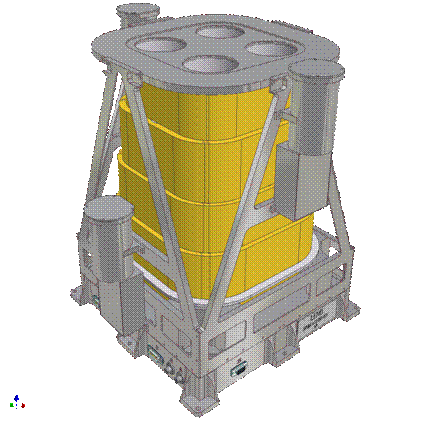
LEND
has eight 3He sensors for detecting thermal and epithermal neutrons.
Four of the 3He sensors un-collimated and four are collimated. As
seen in Figure 2.1. LEND Instrument Overview; external sensors STN1-3 (Sensor Thermal Neutrons) and SETN
(Sensor EpiThermal Neutrons) are the un-collimated sensors that detect thermal
and epithermal neutrons. STN-3 and SETN both have open fields of view. The
combination of these two sensors will allow the measurement of local density of
thermal and epithermal neutrons around the spacecraft. STN 1 and 2 are located
near the midpoint of the instrument and have the thick mass of the collimation
module just between them. For sensors on the +X and -X sides, the collimation
material absorbs all external particles coming from directions –X and +X,
respectively. The velocity vector of LRO will correspond to one of these
directions: therefore, sensors STN 1 and 2 will detect neutrons with velocities
(Vn + Vorb) and (Vn – Vorb),
respectively, and will operate as a Doppler filter to separate the flux of
external neutrons from the Moon from the local spacecraft background. The full
set of four sensors, SETN and STN 1-3, will provide the data to characterize
the neutron component of lunar radiation background at the altitude of LRO
separately from the neutron component of local background produced by LRO
itself.
The collimated sensors of epithermal neutrons, CSETN1-4, are also 3He counters, that are installed inside the collimating module, which effectively absorbs external neutrons outside of instrument Field of View. Absorbing neutrons is very difficult; one of the best absorbing materials is 10B, and its absorption efficiency becomes much higher when neutrons are slower. The LEND collimators have external layers of polyethylene for moderation of impacting neutrons and internal layers of 10B for their efficiency. These sensors are also enclosed by Cd shields that absorb all neutrons with energies below ~0.4 eV, which mainly correspond to thermal neutrons. The neutron collimator provides the instrument Field of View (FOV): epithermal neutrons of direct flux inside the FOV are recorded by the detector, while the majority of neutrons outside the FOV are absorbed by the collimator. This collimation technique provides mapping of epithermal neutrons from the Moon’s surface with the horizontal resolution of 5 km for LRO at an altitude of 50 km.
The final LEND sensor is the Sensor for High Energy Neutrons (SHEN), which is a stylbene scintillator that produces a flash of light each time a high energy neutron in the energy range 0.3 – 15.0 MeV collides with a hydrogen nucleus and creates a recoil proton. Special shape-sensitive electronics distinguish proton counts from electron counts, and an active anti-coincidence shield eliminates external charged particles. This sensor is installed inside the central hole of the collimation unit, and its Field of View corresponds to 40° (HWHM). The SHEN sensor outputs data in 16 energy channels from 300 keV to more than 15 MeV, and is the source of the SC1-3 spectra.
LEND operates autonomously, collecting data throughout the lunar orbit. LEND generates approximately 0.26 Gbits of measurement data per day. In order to perform early calibration measurements, LEND became active shortly after the first mid course correction (MCC) burn. Operationally, LEND is simple and has only three instrument modes: MEASUREMENTS, STAND-BY, and OFF. While in MEASUREMENTS mode, instrument electronics and detector high voltage are both 'on' and the instrument generates measurement and housekeeping data. In STAND-BY mode, instrument electronics are 'on', detector high voltage is 'off', and only housekeeping data are generated. While in OFF mode, the instrument is 'off', the instrument external heater is 'on', and only external temperature data are generated.
For further information about the LEND instrument and the LEND experiment please see Applicable Document [6].
Figure 2.1. LEND Instrument Overview






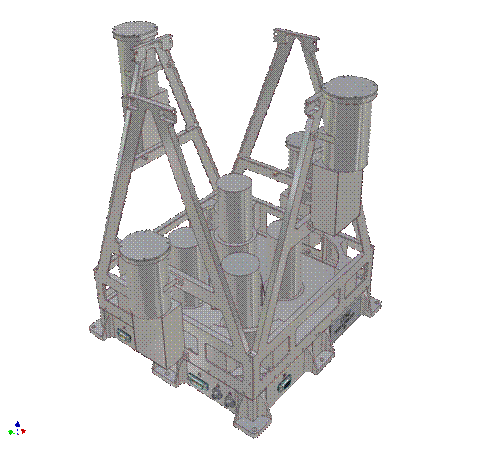

SHEN (inside) SETN STN 1 STN 3 SETN 1-4 (inside)






2.2 Data Product Overview
The LEND EDR data product
contains two types of data.
LEND_SCI_DATA
Neutron Detector
science data
LEND_HK_DATA
Neutron
Detector housekeeping data
LEND_SCI_DATA
is a time series of Neutron Detector science data.
LEND_HK_DATA
is a time series on Neutron Detector housekeeping data
2.3 Data Processing
Data
format is described in Section 3, Detailed Data Product Specifications on page 11. Data volume is a function of collection rate as parameterized by
collection interval. The nominal collection interval is 1 second or 86400 records
per day per file. Collection Interval can be changed in the middle of a time
series file, which can be determined by noting the difference between record
timestamps.
2.3.1 Data Processing Level
The EDR
product contains individual raw LEND spectra and associated data corresponding
to NASA Processing Level 0, CODMAC Level 2 [see Applicable Document 1].
2.3.2 Data Product Generation
A
process termed “ingest” occurs on the LEND Science Operations Center computer
which receives data from the LRO Mission Operation Center. The ingest process
verifies the consistency of the data. The LEND EDR data product is output by
software that maps the stored relational data into the format described by this
SIS. Both processes (ingest and output) are rigorously tested. Multiple versions
of the data product may be made available if software bugs affecting the output
data are uncovered and corrected. In the event of an error whose fix
changes released data, it is expected the data will be reprocessed by the
revised software and made available.
2.3.3 Data Flow
The
LEND-EDR data product will be made available in sequential data releases at
three month intervals as specified in applicable document #1 (Appendix 4, Lunar
Reconnaissance Orbiter Archive Delivery Schedule).
The release schedule for LEND data product archives is strictly within the nominal six-month period for data processing, data validation, archive generation, delivery to the PDS, validation of the delivery by PDS, and PDS archive release to the public. Once released by the PDS, the LEND data will be available online through a set of PDS search and retrieval tools that will provide access to data from all LRO instruments.
2.3.4 Labeling and Identification
The data set ID provided by the
PDS for the LEND EDR data product is:
LRO-L-LEND-2-EDR-V1.0
The version number is
incremented should the entire EDR data set be revised.
The
file naming convention for LEND EDR data files will be the PRODUCT_TYPE value followed
by an eight-digit date specifier in the format YYYYMMDD, e.g. LEND_EDR_SCI_20081223.DAT.
The EDR parts will have a detached PDS label in a separate file of the same
name, extension .LBL.
2.3.5 Data Product Revisions
Individual
EDR products may be revised during the course of the mission. A product's revision
status is recorded in its PDS label using the keyword PRODUCT_VERSION_ID. The
value of this keyword is "1.0" for the first version of a product.
The value is incremented with each product revision. Also, the label keyword PRODUCT_CREATION_TIME
is updated with each product revision.
PRODUCT_VERSION_ID
and PRODUCT_CREATION_TIME appear in the index table for the RDR archive so that
the set of revised products can be easily identified. The index table also includes a
RELEASE_ID keyword to indicate the number of the data release in which the
product was included. The first release of the mission has a RELEASE_ID value
of "0001"; the second release three months later has a value of
"0002", and so on. This keyword is not updated for a revised
product; it always shows the ID of the release in which the product first
appeared.
2.4 Standards Used in
Generating Data Products
2.4.1 PDS Standards
The LEND
EDR data product complies with Planetary Data System standards for file formats
and labels, as specified in the PDS Standards Reference [4].
2.4.2 Time Standards
Time
series datum in the LEND EDR data product is sorted according to the value of spacecraft
clock. Time series records are tagged by spacecraft time which is the 5 MSB of
the spacecraft clock, 4 bytes of seconds and 1 byte of subsecond. The LEND Instrument
contains its own internal clock. Values from this clock are also included,
units are in 0.016 seconds since the last power on of the instrument.
2.4.3 Coordinate Systems
Not Applicable for this data set.
2.4.4 Data Storage Conventions
Binary files
are all fixed-length, stored in most-significant-byte-first (big-endian)
format. In text files each record is terminated with a carriage return followed
by a line feed.
2.5 Data Validation
LEND
EDR products will be validated by the LEND Team for science content and for compliance
with PDS archive standards [Applicable Document 4].
3. DETAILED DATA PRODUCT SPECIFICATIONS
The EDR
data product shall be grouped into directories with one directory per flight
day. Flight day is defined to be midnight-to-midnight UTC. Within each
directory shall be the two labels corresponding to the individual parts of the
data product. The labels will point to one data file each, and contain pointers
to format labels detailing the column layout of the data files.
3.1 Data Product Structure and Organization
In the
DATA directory of the EDR archive, data for each flight day will be in a subdirectory
named in the format YYYYMMDD, indicating the date at the end of the data acquisition period.
3.2 Data Format
The LEND EDR data product
contains two types of data.
LEND_SCI_DATA
Neutron Detector
science data
LEND_HK_DATA
Neutron
Detector housekeeping data
LEND_SCI_DATA
is a time series of Neutron Detector science data.
LEND_HK_DATA
is a time series on Neutron Detector housekeeping data
Each product
type is stored in a separate file with a detached PDS label. All the product
types are stored as binary tables with fixed-length records. Definitions of the
columns in the tables are listed in Table 1.
3.3 Labels and Headers
Each
data file is described by a PDS label in a separate file with the same name, extension
“.LBL”. A label file is stored in the same directory as the data file it
describes. In most cases, the PDS label includes a pointer to another file that
contains the column definitions, in order to avoid repeating the lengthy
definitions in every label. These column definition files have the extension
“.FMT” and are stored in the LABEL directory of the EDR archive.
The
data files themselves do not contain any embedded headers.
Sample
LEND_ SCI_DATA label:
PDS_VERSION_ID = "PDS3"
/*** FILE FORMAT ***/
FILE_RECORDS = 5048
RECORD_TYPE = FIXED_LENGTH
RECORD_BYTES = 370
/*** GENERAL DATA
DESCRIPTION PARAMETERS ***/
PRODUCT_ID =
"LEND_EDR_SCI_20090228_DAT"
PRODUCT_VERSION_ID = "1.0"
PRODUCT_CREATION_TIME = 2009-06-15T19:25:31
PRODUCT_TYPE = "LEND_EDR_SCI"
SOFTWARE_NAME = "GEN_LEND_EDR"
SOFTWARE_VERSION_ID = "1.0.0"
INSTRUMENT_HOST_NAME = "LUNAR RECONNAISSANCE
ORBITER"
INSTRUMENT_NAME = "LUNAR EXPLORATION
NEUTRON DETECTOR"
INSTRUMENT_ID = "LEND"
DATA_SET_ID =
"LRO-L-LEND-2-EDR-V1.0"
MISSION_PHASE_NAME = "NOMINAL MISSION"
TARGET_NAME = "MOON"
START_TIME = 2009-02-28T00:00:00
STOP_TIME = 2009-02-28T23:59:59
SPACECRAFT_CLOCK_START_COUNT = "2311228"
SPACECRAFT_CLOCK_STOP_COUNT = "2397627"
^TABLE =
"LEND_EDR_SCI_20090228.DAT"
OBJECT = TABLE
COLUMNS = 18
INTERCHANGE_FORMAT = BINARY
ROW_BYTES = 370
ROWS = 5048
DESCRIPTION = "
This table contains neutron spectra and
associated instrument
Parameters as observed by the Lunar
Reconnaissance Orbiter (LRO)
Lunar Exploration Neutron Detector (LEND).
Detailed descriptions for the parameters
defined below are
contained in the 'LEND_EDR_SIS' document.
The complete column definitions are
contained in an external file
found in the LABEL directory of the archive
volume.
"
^STRUCTURE =
"LEND_EDR_SCI.FMT"
END_OBJECT = TABLE
END
Sample
LEND_HK_DATA label:
PDS_VERSION_ID
= "PDS3"
/*** FILE FORMAT ***/
FILE_RECORDS
= 470
RECORD_TYPE
= FIXED_LENGTH
RECORD_BYTES
= 61
/*** GENERAL DATA DESCRIPTION PARAMETERS ***/
PRODUCT_ID
= "LEND_EDR_HK_20090228_DAT"
PRODUCT_VERSION_ID
= "1.0"
PRODUCT_CREATION_TIME
= 2009-06-15T19:25:31
PRODUCT_TYPE = "LEND_EDR_HK"
SOFTWARE_NAME
= "GEN_LEND_EDR"
SOFTWARE_VERSION_ID
= "1.0.0"
INSTRUMENT_HOST_NAME
= "LUNAR RECONNAISSANCE ORBITER"
INSTRUMENT_NAME
= "LUNAR EXPLORATION NEUTRON DETECTOR"
INSTRUMENT_ID
= "LEND"
DATA_SET_ID
= "LRO-L-LEND-2-EDR-V1.0"
MISSION_PHASE_NAME
= "NOMINAL MISSION"
TARGET_NAME
= "MOON"
START_TIME
= 2009-02-28T00:00:00
STOP_TIME
= 2009-02-28T23:59:59
SPACECRAFT_CLOCK_START_COUNT
= "2311228"
SPACECRAFT_CLOCK_STOP_COUNT
= "2397627"
^TABLE
= "LEND_EDR_HK_20090228.DAT"
OBJECT
= TABLE
COLUMNS = 26
INTERCHANGE_FORMAT = BINARY
ROW_BYTES = 61
ROWS = 470
DESCRIPTION = "
This table contains
instrument parameters and housekeeping values
as observed by the Lunar
Reconnaissance Orbiter (LRO) Lunar
Exploration Neutron
Detector (LEND).
Detailed descriptions
for the parameters defined below are
contained in the
'LEND_EDR_SIS' document.
The complete column
definitions are contained in an external file
found in the LABEL
directory of the archive volume.
"
^STRUCTURE = "LEND_EDR_HK.FMT"
END_OBJECT
= TABLE
END
4. APPLICABLE SOFTWARE
4.1 Applicable PDS Software Tools
PDS-labeled
images and tables can be viewed with the program NASAView, developed by the PDS
and available for a variety of computer platforms from the PDS web site http://pdsproto.jpl.nasa.gov/Distribution/license.html. There is no charge for NASAView.
PDS
products may also be viewed with the program LRO_LEND_PDS_VIEWER, developed by
the University of Arizona Lunar Planetary Lab.
The LRO_LEND_PDS_VIEWER Data Viewer is a software tool for browsing and
displaying LRO LEND PDS data files in tabular or graphical format, and
label/format files in text format. The tool validates and reads LRO LEND PDS EDR
and RDR files. PDS files may be
acquired through the PDS Geosciences Node.
There is no charge for LRO_LEND_PDS_VIEWER. A setup file is available for download at http://pds-geosciences.wustl.edu/missions/lro/lend.htm under Online Tools.
Running the setup file will install the software and create a start menu
and desktop icon for launching the tool.
Installation requires roughly 5.4 MB of disk space. This software can be run from a Windows based
system that has Java 1.6 or greater installed.
You may download the Java Runtime environment for Windows free at
http://java.com/en/download/inc/windows_upgrade_xpi.jsp
A user
guide for the LEND viewer software may be displayed from its help menu.
Table 1. LEND EDR Data Columns
This table lists the columns in
all LEND EDR data files in alphabetical order. The format of each type of data
file, including column positions, sizes, data types, units, and full
descriptions, can be found in the format files (*.FMT) in the LABEL directory.