PDS Archive Volume Software
Interface Specification (SIS)
For
Mini-RF Advanced Technologies – Lunar Reconnaissance
Orbiter (LRO)
Payload Operations Center
January
28, 2010
Prepared
by
Mini-RF Program
class=Section2>
Prepared by
Mr. Michael Reid Date
Mini-RF POC Data
Archivist
JHU/APL
Reviewed by
Dr. Ben Bussey Date
Mini-RF Principle
Investigator
JHU/APL
Ms. Helene Winters Date
Project Manager
JHU/APL
Approved by
Mr. David B. LaVallee Date
Payload Operations
Center Manager
JHU/APL
Ms. Susan Slavney Date
NASA PDS
Representative, Geosciences Node
Washington University, St. Louis
Dr. Charles Acton Date
NASA PDS
Representative, Navigation & Ancillary Information Facility (NAIF) Node
JPL
|
RECORD OF CHANGES
|
|
CHANGE NO.
|
DATE
|
TITLE
OR BRIEF DESCRIPTION
|
ENTERED BY
|
|
0
|
31 May 2007
|
Initial Release
|
Mike
Reid
|
|
1
|
18 Oct 2007
|
Renamed the INTERFEROMETRY archive
directory to “CONTINOUS”.
|
Mike
Reid
|
|
2
|
11 April 2008
|
Major changes from peer review
|
Mike
Reid
|
|
3
|
8 April 2009
|
Modified section 2.2.2 to mention
the Sandia SAR Stereo Level 3 data product. Changed the front cover logo
from NAWK to Mini-RF.
|
Mike
Reid
|
|
4
|
30 Nov 2009
|
Updated reviewers and approval
page; added ORBNUM/ directory in EXTRAS/; added Arecibo calibration data
CALIB/ARECIBO.
|
Mike
Reid
|
|
5
|
27 Jan 2010
|
Changed contents of CALIB
directory; changed contents of DOCUMENT directory; removed BROWSE directory
and replaced with QUIKVIEW directory under EXTRAS; changed TIFF images to
JPEGs; updated diagrams accordingly; updated data volume sizes in sec. 4.2
to reflect greatly increased data rate.
|
Mike
Reid
|
Table of Contents
1. Introduction................................................................................................................................. 1
1.1. Purpose and Scope............................................................................................................... 1
1.2. Content Overview................................................................................................................ 2
1.3. Applicable Documents and Constraints.............................................................................. 2
1.4. Relationships with Other Interfaces.................................................................................... 2
2. Archive Volume Contents........................................................................................................... 3
2.1. Root Directory Contents..................................................................................................... 4
2.2. DATA Directory Contents and Naming............................................................................. 4
2.2.1. The Burst Mode SAR (SAR) Subdirectory.............................................................. 5
2.2.2. The Continuous Mode (CONTINUOUS) Subdirectory......................................... 6
2.3. INDEX Directory Contents................................................................................................ 6
2.4. DOCUMENT Directory Contents..................................................................................... 7
2.5. Catalog Directory Contents................................................................................................. 8
2.6. EXTRAS Directory............................................................................................................. 9
2.7. Calibration (CALIB) Directory Contents............................................................................ 9
3. Archive Volume Format............................................................................................................ 10
3.1. File Formats....................................................................................................................... 10
3.1.1. Document File Format............................................................................................ 10
3.1.2. Tabular File Format................................................................................................. 11
3.1.3. Spreadsheet File Format.......................................................................................... 11
3.1.4. Raw Format............................................................................................................. 11
3.1.5. Binary File Format.................................................................................................. 11
3.1.6. Mosaic Format........................................................................................................ 11
3.1.7. Image Format........................................................................................................... 12
3.1.8. SPICE Kernels Format............................................................................................ 12
3.1.9. PDS Label Format................................................................................................... 12
3.1.10. Catalog File Format............................................................................................... 13
4. Archive Volume Generation...................................................................................................... 13
4.1. Data Transfer and Validation Methods............................................................................. 13
4.2. Data Product Sizes and Delivery Rates............................................................................. 14
5. Support Staff and Cognizant Persons....................................................................................... 14
6. Glossary.................................................................................................................................... 15
7. Acronyms.................................................................................................................................. 15
This
Software Interface Specification (SIS) is intended to be used by those who wish
to understand the format and content of the Lunar Reconnaissance Orbiter (LRO)
Mini-RF instrument (here referred to as “MRFLRO”) data Archive. Typically,
these individuals would be software engineers, data analysts, or planetary
scientists.
The
specifications in this document apply to all LRO standard product archive
volumes that are generated by the Mini-RF Project. Identifying keywords are
given below in Table 1.The data sets
included on these archive volumes have the following Planetary Data System data
set IDs for the Raw data, Level 1 SAR, Level 1 interferometry, Level 2 SAR,
Level 3 SAR mosaics, and Level 3 Sandia SAR Stereo products respectively:
·
LRO-L-MRFLRO-1-PDR-V1.0
·
LRO-L-MRFLRO-4-CDR-V1.0
·
LRO-L-MRFLRO-4-CDR-INSAR-V1.0
·
LRO-L-MRFLRO-5-CDR-MAP-V1.0
· LRO-L-MRFLRO-5-CDR-MOSAIC-V1.0
·
LRO-L-MRFLRO-5-CDR-STEREO-V1.0
·
LRO-L-SPICE-6-V1.0
|
Keyword
|
Value
|
|
MISSION_NAME
|
"LUNAR
RECONNAISSANCE ORBITER”
|
|
MISSION_ID
|
LRO
|
|
INSTRUMENT_HOST_NAME
|
"
LUNAR RECONNAISSANCE ORBITER "
|
|
INSTRUMENT_HOST_ID
|
LRO
|
|
INSTRUMENT_NAME
|
“MINI-RF
LRO”
|
|
INSTRUMENT_ID
|
MRFLRO
|
Table 1 Values of mission and instrument identifying key words.
1.2. Content Overview
This SIS describes the format, content, and generation of
the MRFLRO Archive. Section 2, Archive Volume Contents,
describes the structure of the archive volumes and the contents of each file.
Section 3, Archive Volume Format,. describes
the file formats used on the archive volumes. Section 4, Archive Volume Generation,
describes the procedure for transferring data products to the archive and data
volumes. Finally, Section 5, Support Staff and Cognizant Persons, lists the individuals
responsible for generating the archive volumes. All data products are produced
and assembled by the Mini-RF Payload Operations Center (POC) located at the
Johns Hopkins University Applied Physics Laboratory (JHU/APL) located in
Laurel, Maryland.
This Archive Volume SIS is intended to be consistent with
the following documents:
1.
PDS Data Product Software
Interface Specification (SIS) For Mini-RF Advanced Technologies – Lunar
Reconnaissance Orbiter (LRO) Payload Operations Center, Mini-RF Program.
MRF-4009.
2.
Planetary Data System Archive Preparation
Guide, August 29, 2006, Version 1.1, JPL D-31224.
3.
Planetary Data System Standards Reference, NASA/JPL, February 27, 2009, Version 3.8.
JPL D-7669, Part-2. Available from http://pds.jpl.nasa.gov/documents/sr/index.html. [Accessed: January 26, 2010].
4.
LRO Mini-RF Science Team and PDS Geosciences Node Interface Control
Document (ICD).
5.
Lunar Reconnaissance Orbiter Data
Management and Archive Plan, 431-PLAN-000182, NASA/GSFC LRO Project.
This Archive Volume SIS could be affected by changes to the
design of the LRO standard data products. See the data product SIS (MRF-4009)
[section 1.3]. LRO project SPICE kernels and any generated at the POC will be
archived separately at the NAIF PDS node.
2. Archive
Volume Contents
This
section describes the contents of the MRFLRO
Archive volumes, including the file names, file contents, file types, and
organization responsible for providing the files. All products are included in
a single archive volume (Volume ID: LROMRF_0XXX).
The
data products consist of binary images, non-image binary data, supporting data
in free-formatted text files, spreadsheet (comma separated values) text files,
and “CONI” text. CONI is a human and machine-readable structured text format
developed by Vexcel® corporation and is the standard parameter file
format for their SAR processors. We include these parameter files with the
products as metadata.
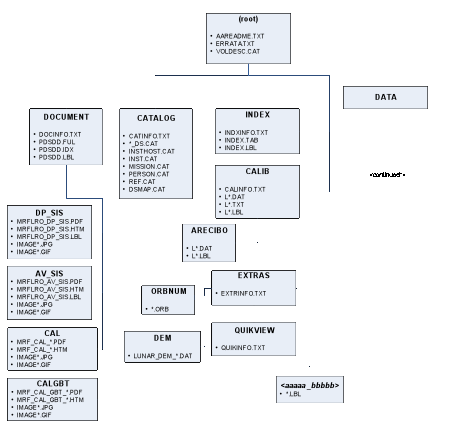
Figure 1 Root
directory of the archive and its immediate subdirectories. *The
DATA subdirectory is given in Figure 2.
Files
in the root directory include an overview of the archive, a description of the
volume for the PDS Catalog, and a list of errata or comments about the archive.
The following files are contained in the Root Directory.
|
File Name
|
File Contents
|
File Provided By
|
|
AAREADME.TXT
|
Volume content and format information with an attached
PDS label. This file also contains a description of publicly available
software, which was used in generating the products and which might be
useful in analyzing them.
|
POC
|
|
ERRATA.TXT
|
A cumulative listing of comments and updates concerning
all archive volumes published to date
|
POC
|
|
VOLDESC.CAT
|
A description of the contents of this volume in a PDS
format readable by both humans and computers
|
POC
|
Table 2 Root directory contents.
The Data Directory contains the delivered science data
products. Under the DATA directory
there is a separate subdirectory for the two types of science products, SAR and
interferometry. These directories are named SAR and CONTINUOUS
respectively. The SAR and continuous mode subdirectories are further divided
into a single subdirectory for the Level 3 mosaic products and multiple subdirectories
for the lower-level products. There is no Level 2 continuous mode directory.
The subdirectories for the lower-level products are named
based on the number of the orbit during which the original raw data were
collected. The directory naming scheme contains two five-digit natural numbers
separated by an underscore. The first number aaaaa is the number of the first orbit and the second number bbbbb is the number of the last orbit
represented in the directory. In other words, a directory named “00402_00578”
contains all data collected in orbits 402 through 578. The orbit numbers given
in the directory names are padded with leading zeroes. The number of orbits
represented in a given directory will be determined by the investigator who
creates the product set. There will be multiple directories of this type.
Additional orbit numbered directories will be added to the archive with each
delivery to the PDS over the lifetime of the mission.
Within each orbit numbers directory, there is a subdirectory
for the raw data and each level of science data processing up to, but not
including the Level 3 mosaics. The Level 3 SAR products reside in a separate MOSAICS directory at the same level as
the orbit number directories because the mosaic products are constructed from
data acquired during multiple orbits and are therefore not associated with one
particular orbit. The Level 3 continuous mode products reside in the ../CONTINUOUS/LEVEL3 directory. The data
product SIS document [1.3] describes the naming convention for the files that
reside within these subdirectories.
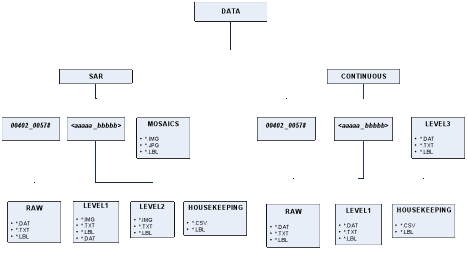
Figure 2 DATA subdirectory (under root) and its subdirectories. The subdirectories
titled “00402_00578” are examples of what the orbit-associated product
directories following the aaaaa_bbbbb
naming format would look like.
The SAR directory
contains the science data collected by the LRO instrument while operating in
“burst” mode. The orbit number subdirectories within this directory contain
raw, level 1, and level 2 products. They do not contain level 0 products, as
these are not archived at the PDS. The mosaic (MOSAICS) subdirectory contains the Level 3 SAR mosaics.
|
Subdirectory Name
|
Directory Contents
|
File Provided By
|
|
<aaaaa_bbbbb>/RAW
|
The Raw data directory contains the Packetized Data
Records (PDR) or “Raw” data. These data are unprocessed CCSDS packets. They
are provided to the PDS in “safed” form and are accompanied by minimal PDS labels.
No formatting is done on them.
|
POC
|
|
<aaaaa_bbbbb>/HOUSEKEEPING
|
Housekeeping data associated with the collection period.
|
POC
|
|
<aaaaa_bbbbb>/LEVEL1
|
The Level 1 SAR science data products including PDS
labels. These contain processed binary data products and ancillary data in structured
text files. This directory contains the original CDR image file produced by
the Level 1 SAR processor and ancillary data files.
|
POC
|
|
<aaaaa_bbbbb>/LEVEL2
|
The Level 2 SAR science data products including PDS
labels. These contain processed binary data products and ancillary data in structured
text files. This directory contains the original image file produced by the
Level 2 SAR processor, 4 stokes parameter files, 3 derived parameter files
(SSP, OSP, CPR) and ancillary data files.
|
POC
|
|
MOSAICS
|
The Level 3 (mosaic) SAR science data products including
PDS labels. These contain binary images and JPEG image files.
|
POC
|
Table 3 Description
of the contents of the numbered orbit subdirectories within the SAR directory.
The CONTINUOUS
directory contains the science data collected will the Mini-RF instrument was
operating in “continuous” mode. These are the data sets that can be used for
generating interferometric products. The orbit number subdirectories within this
directory contain raw and Level 1 products. They do not contain Level 0
products as these are not archived at the PDS and there are no Level 2
continuous mode products. The LEVEL3 directory contains the SAR Stereo Level 3
derived data products produced by Sandia National Laboratory and accompanying
parameter files.
|
Subdirectory Name
|
Directory Contents
|
File Provided By
|
|
<aaaaa_bbbbb>/RAW
|
The Raw data directory contains the Packetized Data
Records (PDR) or “Raw” data. These data are unprocessed CCSDS packets. They
are provided to the PDS in “safed” form and are accompanied by minimal PDS
labels. No formatting is done on them.
|
POC
|
|
<aaaaa_bbbbb>/LEVEL1
|
The Level 1 continuous mode science data products
including PDS labels. These contain processed binary data products and
ancillary data in spreadsheet (CSV) and structured text files. This
directory contains the original continuous mode CDR file produced by the
Level 1 processor and ancillary data files.
|
POC
|
|
<aaaaa_bbbbb>/HOUSEKEEPING
|
Housekeeping data associated with the collection period.
|
POC
|
|
LEVEL3
|
The SAR Stereo data products and accompanying parameter
files.
|
POC
|
Table 4 Description
of the contents of the numbered orbit subdirectories within the CONTINOUS
directory. <aaaaa_bbbbb> indicates the number of the first orbit
represented in the directory aaaaa and the number of the last orbit represented
in the directory bbbbb.
Files
in the INDEX Directory are provided to help the user locate products on this
archive volume and on previously released volumes in the archive. The following
files are contained in the Index Directory.
|
File Name
|
File Contents
|
File Provided By
|
|
INDXINFO.TXT
|
A description of the contents of this directory.
|
POC
|
|
INDEX.TAB
|
Table listing all data products on this volume. Table 6 below describes this file.
|
POC
|
|
INDEX.LBL
|
A PDS detached label that describes INDEX.TAB
|
POC
|
|
MD5.TAB
|
MD5 checksum file.
|
POC
|
|
MD5.LBL
|
A PDS detached label that describes the MD5.TAB file.
|
|
Table 5 Contents of the Index directory. The FILE_SPECIFICATION_NAME is
the name of the PDS label.
|
Column
|
Format
|
Length (bytes)
|
Example
|
|
VOLUME_ID
|
CHARACTER
|
15
|
“LROMRF_1001”
|
|
DATA_SET_ID
|
CHARACTER
|
33
|
"LRO-L-MRFLRO-3-CDR-V1.0”
|
|
PRODUCT_ID
|
CHARACTER
|
27
|
"LSL_CDR_LV1_00310_1Q”
|
|
PRODUCT_TYPE
|
CHARACTER
|
15
|
"CDR”
|
|
FILE_SPECIFICATION_NAME
|
CHARACTER
|
150
|
"LROMRF_0XXX/DATA/SAR/00000_00499/LEVEL1/LSL_CDR_LV1_00310_1Q.LBL”
|
|
PRODUCT_CREATION_TIME
|
TIME
|
20
|
"2008-01-06T16:33”
|
|
START_TIME
|
TIME
|
30
|
"2007-11-01T19:03:13.462283”
|
|
STOP_TIME
|
TIME
|
30
|
"2007-11-01T19:04:28.3802”
|
|
SPACECRAFT_CLOCK_START_COUNT
|
CHARACTER
|
30
|
"1/1234567890.54321”
|
|
SPACECRAFT_CLOCK_STOP_COUNT
|
CHARACTER
|
30
|
"1/1234568890.12345”
|
|
ORBIT_NUMBER
|
CHARACTER
|
7
|
“310”
|
Table 6 The contents and format of the INDEX.TAB file. Each record in
the table will be composed of these fields and there will be one record for
every product file in the archive.
The
DOCUMENT Directory contains documentation to help the user understand and use
the archive data. The following files are contained in the Document Directory.
Files linked to the HTML (*.HTM) version of the documents will be stored in
subdirectories of the same name as the document (without the file suffix). Each
document is stored in its own subdirectory.
|
File Name
|
File Contents
|
File Provided By
|
|
DOCINFO.TXT
|
A description of the contents of this
directory
|
POC
|
|
DP_SIS/MRFLRO_DP_SIS.HTM
|
The Data Product SIS as hypertext.
This may be several files.
|
POC
|
|
DP_SIS/MRFLRO_DP_SIS.PDF
|
The Data Product SIS as a PDF file
|
POC
|
|
DP_SIS/MRFLRO_DP_SIS.LBL
|
A PDS detached label that describes
both MRFLRO_DP_SIS.HTM and MRFLRO_DP_SIS.PDF
|
POC
|
|
AV_SIS/MRFLRO_AV_SIS.HTM
|
The Archive Volume SIS (this document)
as hypertext. This may be several files.
|
POC
|
|
AV_SIS/MRFLRO_AV_SIS.PDF
|
The Archive Volume SIS (this document)
as a PDF file
|
POC
|
|
AV_SIS/MRFLRO_AV_SIS.LBL
|
A PDS detached label that describes
both MRFLRO_AV_SIS.HTM and MRFLRO_AV_SIS.PDF.
|
POC
|
|
CAL/MRF_CAL_MCKERRACHER_ET_AL2010.PDF
|
A description of Mini-RF calibration as
a PDF file
|
POC
|
|
CAL/MRF_CAL_MCKERRACHER_ET_AL2010.HTM
|
The calibration description as an HTML
document (this will actually be a set of files containing both HTML text and
images).
|
POC
|
|
CAL/MRF_CAL_MCKERRACHER_ET_AL2010.LBL
|
A PDS detached label that describes
both MRF_CAL_MCKERRACHER_ET_AL2010.HTM and MRF_CAL_MCKERRACHER_ET_AL2010.PDF
|
POC
|
|
GBTCAL/MRFLRO_CAL_GBT_JENSEN2009.PDF
|
A description of Mini-RF calibration
activities using data from the Greenbank Radio Telescope (GBT) as a PDF file
|
POC
|
|
GBTCAL/MRFLRO_CAL_GBT_JENSEN2009.HTM
|
The GBT calibration description as an
HTML document (this will actually be a set of files containing both HTML text
and images).
|
POC
|
|
GBTCAL/MRFLRO_CAL_GBT_JENSEN2009.LBL
|
A PDS detached label that describes
both MRFLRO_CAL_GBT_JENSEN2009.HTM and MRFLRO_CAL_GBT_JENSEN2009.PDF
|
POC
|
|
PDSDD.FUL
|
Identifies and describes the data
object and data element definitions contained in the Planetary Science Data
Dictionary (PSDD).
|
PDS
|
|
PDSDD.IDX
|
An index of the PDSDD.FUL and is
currently used by the PDS validation tools to quickly locate individual
elements in the PSDD.
|
PDS
|
|
PDSDD.LBL
|
A detached PDS label describing the
PDSDD.FUL and PDSDD.IDX files.
|
PDS
|
Table 7 Contents of the Document directory.
The
files in the Catalog Directory provide a top-level understanding of the
mission, spacecraft, instruments, and data sets. The files in this directory
are coordinated with the PDS data engineer, who is responsible for loading them
into the PDS catalog. The following files are found in the Catalog Directory.
|
File Name
|
File Contents
|
File Provided By
|
|
CATINFO.TXT
|
A description of the contents of this directory
|
POC
|
|
*_DS.CAT
|
Data set information for the PDS catalog (one file per
data set). The file name will reflect the DATA_SET_ID, but will comply with
PDS file naming standards. It will be composed of the DATA_SET_ID minus the
“LRO-L-” prefix, all dashes and periods replaced with underscores, and
_DS.CAT appended to the end. For example, the catalog file for the data set
LRO-L-MRFLRO-4-CDR-V1.0 would be
named MRFLRO_4_CDR_V1_0_DS.CAT.
|
POC
|
|
INSTHOST.CAT
|
Instrument host (i.e., spacecraft) information for the PDS
catalog
|
POC
|
|
INST.CAT
|
Instrument information for the PDS catalog
|
POC
|
|
MISSION.CAT
|
Mission information for the PDS catalog
|
POC
|
|
PERSON.CAT
|
Personnel information for the PDS catalog (Team and PDS
personnel responsible for generating the archive)
|
POC
|
|
REF.CAT
|
References mentioned in other *.CAT files
|
POC
|
|
DSMAP.CAT
|
Contains the map projection equations for the Level 2
products.
|
POC
|
Table 8 Contents of the Catalog directory.
2.6. EXTRAS Directory
The delivered Digital Elevation Model (DEM) files which were
used in science product generation and the orbit number files that associate
orbit numbers with lunar location and time will be provided in the EXTRAS
directory.
|
File Name
|
File Contents
|
File Provided By
|
|
EXTRINFO.TXT
|
A description of the contents of this directory
|
POC
|
|
DEM/LUNAR_DEM_<data>_<ver>.DAT
|
Project-generated lunar DEM files.
|
POC
|
|
ORBNUM/*.ORB
|
A text file that associates the orbit numbers with a
location on the Moon and the start times of the orbit.
|
POC
|
|
QUIKVIEW
|
A set of JPEG images of the Level 2 ST1 and CPR product
files.
|
POC
|
Table 9 Contents of the Extras directory.
The Calib Directory contains calibration files used to
process the data products, or calibration data needed to use the data products.
The following files are contained in the CALIB
Directory. There may be multiple versions of each file distinguished by the <date> section of the file name.
The calibration files are associated with the Level 1 products data set (LRO-L-MRFLRO-4-CDR-Vn.n). See the data product SIS document
for the naming conventions applied to these files.
|
File Name
|
File Contents
|
File Provided By
|
|
CALINFO.TXT
|
A description of the contents of this directory
|
POC
|
|
LfB_RPD_yyyymmddhhmm_Vv.DAT
|
Raw calibration data. f
is the band S or X, yyyymmddhhmm
is the date and time, v is the
version number.
|
POC
|
|
LfB_RPD_yyyymmddhhmm_Vv.LBL
|
Minimal PDS label describing the calibration file.
|
POC
|
|
ARECIBO/LfA_RPD_yyyymmddhhmm_Vv.DAT
|
Raw Arecibo calibration data. f is the band S or X, yyyymmddhhmm
is the date and time, v is the
version number.
|
POC
|
|
ARECIBO/ LfA_RPD_yyyymmddhhmm_Vv.LBL
|
Minimal PDS label describing the Arecibo calibration
file.
|
POC
|
Table 10 Contents of the CALIB calibration data directory.
3. Archive Volume Format
This
section describes the format of MRFLRO Archive Volumes. Data that comprise the
Archive will be formatted in accordance with Planetary Data System
specifications [Applicable Documents 4 and 5]. There will be only one archive
volume, and its VOLUME_ID is LROMRF_0XXX.
Archive
Volumes are delivered to the PDS electronically through a secure file transfer
protocol (sftp) connection.
3.1. File Formats
This
section describes file formats for the kinds of files contained on Archive
Volumes.
Document
files with the .TXT suffix exist in the Root, Index, Software, Catalog, and
Label directories. They are ASCII files which may have embedded PDS labels.
Lines in a .TXT file end with a carriage return character (ASCII 13) and a line
feed character (ASCII 10). This allows the files to be readable under various
operating systems.
Documents
in the Document directory contain formatting and figures that cannot be
rendered as ASCII text. Therefore each document is given in two formats,
hypertext and PDF. The hypertext file contains ASCII text plus hypertext markup
language (HTML) commands that enable it to be viewed in a Web browser such as
Mozilla, Apple Safari, or Microsoft Internet Explorer. The hypertext file is
accompanied by referenced files such as images that are incorporated into the
document by the Web browser. The second format, PDF (Portable Document Format)
is a format from Adobe Systems Incorporated that is frequently used for
distributing documents. Adobe offers free software, Acrobat Reader, for
viewing PDF files.
Tabular
files (.TAB suffix) exist in the Index directory. Tabular files are ASCII files
formatted for direct reading into many database management systems on various
computers. All fields are separated by commas, and character fields are
enclosed in double quotation marks ("). (Character fields are padded with
spaces to keep quotation marks in the same columns of successive records.)
Character fields are left justified, and numeric fields are right justified.
The "start byte" and "bytes" values listed in the labels do
not include the commas between fields or the quotation marks surrounding
character fields. The records are of fixed length, and the last two bytes of
each record contain the ASCII carriage return and line feed characters. This
allows a table to be treated as a fixed length record file on computers that
support this file type and as a text file with embedded line delimiters on
those that don't.
All
tabular files are described by detached PDS labels. The PDS label file has the
same name as the data file it describes, with the extension .LBL; for example,
the file INDEX.TAB is accompanied by the detached label file INDEX.LBL in the
same directory.
Some ancillary text data are provided in spreadsheet format.
A spreadsheet file is a comma-delimited ASCII text file (.CSV suffix).
Spreadsheet files are designed to be easily read by third-party spreadsheet
software such as Microsoft Excel, Open Office, and others. Unlike Tabular
files, spreadsheet files are not of fixed record length and character fields
are not padded with spaces and no left or right justification is done. As with
all delivered text files, the last two bytes of each record contain the ASCII
carriage return and line feed characters.
All spreadsheet files are described by detached PDS labels.
The PDS label file has the same name as the data file it describes, with the
extension .LBL. The PDS label gives a complete description of every field in
the spreadsheet (see Planetary Data System Standards Reference [3], section A.28).
The Raw or Packetized Data Records (PDR) files contain
binary and unprocessed CCSDS packet data. These are provided with only minimal
PDS labels. The PDS label file has the same name as the data file it
describes, with the extension .LBL.
The RAW data and certain supporting products are provided as
binary tables. These products consist of numerical data in big-endian format.
They are accompanied by detached full PDS labels.
The Level 3 mosaics are created using the Integrated
Software for Imaging Spectrometers (ISIS) software from the USGS. These are
images comprised of calibrated data from multiple orbits. They are single band
raw binary images consisting of 32-bit floating point pixels. They are also
provided as TIFF images. They are accompanied by detached full PDS labels.
The primary Level 1 and Level 2 science data products as
well as some of the supporting data are provided as binary image files. They
contain data of both numeric and character types. The data are written in
little-endian (PC_REAL) format.
All binary files are described by detached PDS labels. The
PDS label file has the same name as the data file it describes, with the
extension .LBL. The PDS label gives a complete description of every field in
the data file.
Mosaics will also be provided as image files in JPEG-compressed
format. All JPEG files are described by detached PDS labels, which comply with
the PDS standard regarding images. Quickview images will be provided as JPEG files.
Geometry, ephemeris, and attitude information are provided
in SPICE kernels. SPICE kernels can contain either binary or text data.
All SPICE files are described by detached PDS labels. The
PDS label file has the same name as the data file it describes, with the
extension .LBL. The PDS standards provide a label standard for SPICE kernels
(see Planetary Data System Standards Reference [1.3], section
A.27). This standard will be followed for the LRO SPICE kernels archived by
the POC. LRO SPICE kernels are delivered directly to the NAIF PDS node and are
not part of this archive. They are mentioned here only for informational
purposes.
All
data files in the archive have PDS labels, either embedded at the beginning of
the file or detached in a separate file. For examples of PDS labels for each
type of data product, see the Data Product SIS [Applicable Document 3].
A
PDS label, whether embedded or detached from its associated file, provides
descriptive information about the associated file. The PDS label is an
object-oriented structure consisting of sets of 'keyword=value' declarations.
The object to which the label refers (e.g. IMAGE, TABLE, etc.) is denoted by a
statement of the form:
^object
= location
in
which the carat character (^, also called a pointer in this context) indicates
where to find the object. In an embedded label, the location is an integer
representing the starting record number of the object (the first record in the
file is record 1). In a detached label, the location denotes the name of the
file containing the object, along with the starting record or byte number, if
there is more than one object in the file. For example:
^HEADER
= ("F01.IMG",1)
^IMAGE
= ("F01.IMG",1025 <BYTES>)
indicates
that the IMAGE object begins at byte 1025 of the file F01.IMG, in the same
directory as the detached label file. Below is a list of the possible formats
for the ^object definition.
^object =
n
^object =
n<BYTES>
^object =
"filename.ext"
^object =
("filename.ext",n)
^object =
("[dirlist]filename.ext",n)
^object =
("filename.ext",n<BYTES>)
^object =
("[dirlist]filename.ext",n<BYTES>)
where
n is the starting record or byte number of the object,
counting from the beginning of the file (record 1, byte 1),
<BYTES> indicates that the number given is in units of bytes,
filename is the up to 27 character, alphanumeric upper‑case
file name,
ext is the 3 character upper‑case file extension,
dirlist is a period‑delimited path‑list of parent
directories, in upper case, that specifies the object file directory (used only
when the object is not in the same directory as the label file). The list
begins at the directory level below the root directory of the CD‑ROM.
'[dirlist]' may be omitted when the object being described is located either in
the same directory as the detached label, or in a subdirectory named LABEL that
is located in a higher level of the directory tree, typically the CD‑ROM
root itself.
A
reference to an external text file would be indicated by the ^TEXT keyword.
For example:
^TEXT
= ("FILENAME.TXT")
A
reference to a separate spreadsheet (CSV) file would be indicated by the
^SPREADSHEET keyword. For example:
^SPREADSHEET
= ("L_CAL_PPF_20070011000_01.CSV")
Lines
of text in detached labels end with a carriage return character (ASCII 13) and
a line feed character (ASCII 10). This allows the files to be readable under
various operating systems.
Catalog
files (suffix .CAT) exist in the Root and Catalog directories. They are text
files formatted in an object-oriented structure consisting of sets of
'keyword=value' declarations.
Initially, the entire data archive is produced at the
Payload Operations Center (POC) and delivered to the PDS Geosciences node on a
detachable hard drive or through electronic transfer. The POC will make
multiple deliveries to the PDS. Only new or changed files will be delivered in
subsequent deliveries. If the POC generates any SPICE kernels, it will deliver
them separately to the NAIF PDS node.
There are two parts to the
SAR/interferometry data collects:
1. Monthly four-minute collect
2. Semi-annual four two-minute collects on
consecutive orbits
It is three months after the latter that
data are submitted to the PDS. This will include, however, many
monthly four-minute data takes in addition to the set of four two-minute
takes.
|
Product
|
Product Size Per
Day
|
Expected Number of
Products for Primary 1-Year Mission
|
Expected Total Data
Volume for Primary Mission
|
|
Raw SAR
|
29 GB
|
2130
|
10 TB
|
|
Level 1
|
46 GB
|
2130
|
16 TB
|
|
Level 2
|
52 GB
|
2130
|
18 TB
|
|
Level 2 Stokes & Polarization products
|
24 GB
|
14910
|
9 TB
|
|
Level 3 (mosaic)
|
N/A
|
16
|
4 GB
|
|
Ancillary data
|
5 MB
|
2130
|
2 GB
|
|
Quick View JPEG Image Files
|
4 GB
|
4260
|
2 TB
|
|
Pre-Mission Collection*
|
N/A
|
N/A
|
5 TB
|
|
Total
|
155 GB
|
27706
|
60 TB
|
Table 11 Summary of
the estimated sizes and production rates for the LRO standard products. Note
that product sizes are based on estimated upper limits, so the expected total
is not the product of the size per day and the number of products. This assumes
355 collection days during the regular mission and an average of 6 collections
per day.
*Includes data taken prior to the September 20, 2009 official
beginning of the science mission. These were not collected continuously.
|
Name
|
Affiliation
|
Role on Project
|
Address
|
e-mail
|
|
Dr. D. Ben Bussey
|
JHU/APL
|
Principal Investigator
|
11100 Johns Hopkins Rd, Laurel, MD 20723
|
ben.bussey@jhuapl.edu
|
|
Helene Winters
|
JHU/APL
|
Program Manager
|
11100 Johns Hopkins Rd, Laurel, MD 20723
|
helene.winters@jhuapl.edu
|
|
Dave LaVallee
|
JHU/APL
|
POC Manager
|
11100 Johns Hopkins Rd, Laurel, MD 20723
|
dave.lavallee@jhuapl.edu
|
|
Mike Reid
|
JHU/APL
|
Data Archivist
|
11100 Johns Hopkins Rd, Laurel, MD 20723
|
mike.reid@jhuapl.edu
|
|
Susan Slavney
|
PDS Geosciences Node, Washington University in St. Louis
|
PDS Representative
|
1 Brookings Drive
Campus Box 1169
St. Louis, MO 63130
|
Susan.Slavney@wustl.edu
|
Table 12 List of key
personnel on the LRO/Mini-RF project.
Archive
– An
archive consists of one or more data sets along with all the documentation and
ancillary information needed to understand and use the data. An archive is a
logical construct independent of the medium on which it is stored.
Archive
Volume, Archive Volume Set – A volume is a unit of media on which data products are stored;
for example, one CD-ROM or DVD-ROM. An archive
volume is a volume containing all or part of an archive; that is, data
products plus documentation and ancillary files. When an archive spans multiple
volumes, they are called an archive
volume set. Usually the documentation and some ancillary files are repeated
on each volume of the set, so that a single volume can be used alone.
Catalog
Information
– Descriptive information about a data set (e.g. mission description,
spacecraft description, instrument description), expressed in Object
Description Language (ODL) which is suitable for loading into a PDS catalog.
Data Product – A labeled grouping
of data resulting from a scientific observation, usually stored in one file. A
product label identifies, describes, and defines the structure of the data. An
example of a data product is a planetary image, a spectrum table, or a time
series table.
Data Set
– An
accumulation of data products. A data set together with supporting
documentation and ancillary files is an archive.
Standard Data Product
– A data product generated in a predefined way using well-understood
procedures, processed in "pipeline" fashion. Data products that are
generated in a nonstandard way are sometimes called special data products.
APL (The
Johns Hopkins University) Applied Physics Laboratory
ASCII American
Standard Code for Information Interchange
CCSDS Consultative
Committee for Space Data Systems
CDR Calibrated
Data Record
DEM Digital
Elevation Model
GB Gigabyte
(220 bytes)
GSFC Goddard
Space Flight Center
IK Instrument
Measurement Kernel (SPICE)
ISIS Integrated
Software for Imaging Spectrometers (USGS software)
JHU/APL The
Johns Hopkins University Applied Physics Laboratory
JPEG Joint
Photographic Experts Group (image compression algorithm)
LRO Lunar
Reconnaissance Orbiter
NAIF Navigation
and Ancillary Information Facility
NASA National
Aeronautics and Space Administration
NAWC Naval
Air Warfare Center
ODL Object
Description Language
PDF (Adobe)
Portable Document Format
PDR Packetized
Data Records
PDS (NASA)
Planetary Data System
POC Payload
Operations Center
PVL Parameter
Value Language
SAR Synthetic
Aperture Radar
SCLK Spacecraft
Clock Kernel (SPICE)
SFTP Secure
File Transfer Protocol
SPICE Spacecraft,
Planet, Instrument, C-matrix Events
TB Terabyte
(230 bytes)
USGS United
States Geological Survey
UTC Coordinated
Universal Time