Notes on Alpha-Particle X-ray Spectrometer (APXS) Data
Reduction
R. Gellert, J. Brückner, G. Dreibus, G. W.
Lugmair, R. Rieder, H. Wänke and J. Zipfel,
Max-Planck-Institut für Chemie, Department of
Cosmochemistry, Becher-Weg 27, D-55128 Mainz, Germany
J.L. Campbell, J. Maxwell and M. Omand
Department of Physics, University of Guelph, Guelph,
Ontario, Canada N1G 2W1
Introduction
The Alpha-Particle X-ray Spectrometers (APXS) [1] on board
of NASA's MER-rovers Spirit and Opportunity
are small instruments, with which the chemical composition
of rocks and soil can be measured by simply holding them
against a sample for some time (from 10 minutes to several
hours - the longer, the more accurate). The instruments
have high sensitivity and selectivity for all essential
rock-forming elements, because they employ radioactive
sources of 244Cm for excitation, and novel x-ray
detectors for registration of the characteristic x-rays,
emitted by the atoms in the sample: the sources emit alpha
particles and x-rays, thereby effectively exciting light
atoms, like Na, Mg, Al, or Si, as well as heavier atoms
like Fe, Ni, Zn or Br. These sources have been especially
developed for use in the APXS by the Russian Central
Research Institute for Atomic Reactors in Dimitrovgrad [2].
They consist of a thin layer of curium-silicide on highly
polished semiconductor-grade silicon wafers. The
detectors are silicon drift-chamber designs,
manufactured from high-purity, high-resistivity silicon by
modified integrated circuit manufacturing techniques
(processing of both sides of a silicon wafer is required),
and containing matched first stage preamplifier transistors
on the detector chips. This design results in an extremely
small effective detector/amplifier-input capacitance. Due
to this fact and to very small leakage currents (both bulk
and JFET gate) these detectors exhibit excellent low-noise
performance at temperatures close to ambient. They are a
German development and are commercially available from
Ketek GmbH, Munich[3]. It is most unfortunate that this
feature could not be fully exploited with the flight
instruments in their flight configuration: good resolution
could only be obtained at temperatures below -30 °C. To
explain the reasons is beyond the scope of this note:
suffice it to say that we have only become aware of the
circumstances at the time of integration, and that nothing
could be done to resolve the problem at this late moment.
In the test configuration the flight instruments did indeed
deliver spectra with good resolution at temperatures as
high as ‑10 °C and would have been perfectly
suitable for touch-and go campaigns.
To illustrate the advantages of the alpha plus x-ray
excitation approach, Fig.1 shows a comparison of
spectra, obtained with the same sample (SSK 1.1, an
andesite from a South Pacific island, which is similar in
composition to the rocks at the Mars-Pathfinder landing
site), using (a) combined excitation by alpha particles and
x-rays (Pu L-series) from a 244Cm source, (b)
excitation by x-rays from a 244Cm source only
(alpha particles are blocked by a thin aluminium foil), and
(c) excitation by a 20 keV electron-beam in a Scanning
Electron Microscope.

Fig 1: Comparison of x-ray spectra obtained with different
excitation sources. Sample: SSK 1.1 (Andesite)
Fig. 2 shows a photograph of the flight sensor, and Fig. 3
shows the location of the APXS on the rover's Instrument
Deployment Device.
Calibration Samples and Procedures
All instruments built for NASA-MER (two flight units, two
flight-spares, and one identical lab-reference
model, besides a fully functional engineering model) have
been calibrated, using 11 complex rock samples, high purity
metal oxides (sputter targets), metals and a special
calibration-standard for cross-calibration. Most
rock samples are either certified geo-standards, or
samples with an independent analysis of their composition,
obtained in our own laboratory and/or other laboratories
with qualified records. An additional number of about 20
rock samples (equally qualified) and about 40 analytical
grade chemical compounds have been used in an extended
calibration campaign with the lab‑reference
model only. On the basis of a careful cross-calibration,
results can be applied to the flight instruments, as well.
The various instruments can be easily cross calibrated by
comparing the response, which in this case mainly means
elemental peak areas, of each instrument when identical
samples are measured under identical conditions. To this
end individual cross-calibration factors have been
established on an element by element basis, which take care
of subtle differences between the instruments in terms of
thickness of detector entrance windows and source exit
windows, as well as different source strength of the
excitation sources.
All samples are in the form of ground powder with
grain-sizes of usually less than 100 µm. Some rock
samples were also available in the form of cut plates.
Agreement of data measured with powders and cut plates is
generally good, although there are deviations that require
further study (grain-size effects, etc.). Measurements of
these samples were performed both under vacuum (at a
pressure of less than 10-2 mbar) and in a
simulated Martian atmosphere (CO2 at a pressure
of 10 mbar). Special care was taken with respect to a
reproducible sample-instrument geometry (flat sample
surface; distance error of less than 0.05 mm), and samples
were dried in vacuum at 120°C for several hours prior
to exposure to the instrument.
Spectrum Deconvolution (Peak Fitting)
To extract element-specific information (peak intensities),
the measured complex spectra must be deconvoluted.
This is done by performing non-linear least squares fits,
using the well-known code MINUIT [4]. The mathematical
model, describing the spectral contributions, consists of
functions describing the individual peaks of each element
(up to 5 lines per element), exponential tailing at the low
energy side of the peaks, a background component due to
Compton scattering, a general background component due to
Bremsstrahlung, and functions describing the distributions
resulting from elastic (Rayleigh -Thomson) and inelastic
(Compton) scattering of the exciting x-radiation in the
sample. Instead of using the more common Gauss-function to
describe the individual peaks, this model uses error
functions (integrals of Gauss‑functions). This
approach has yielded significant improvements, when peaks
extend over only a few channels in the spectrum. Parameters
of the model functions have been derived in individual
fitting procedures with simpler single-element spectra, and
are kept fixed relative to one another, when fitting more
complex spectra. Inspection of the residua reveals that the
agreement between the model and the measured data is
usually well within the limits defined by counting
statistics.
Matrix Correction and Derivation of Concentrations
Theoretical x-ray yields have been calculated for all
calibration samples, using the computer codes YLD (for
alpha-excitation) and XRFY (for x-ray excitation), provided
by Campbell et al. [5]. These codes model the physical
processes for alpha- and x-ray-excitation (PIXE and XRF),
assuming a homogeneous matrix, a smooth surface, and well
defined entrance- and exit-angles. From these yields we
determined matrix-factors that describe the x-ray
intensities (per unit concentration) of each element in the
matrices of the individual calibration samples, relative to
an average intensity (per unit concentration) of the whole
set of samples. One of the results of these model
calculations was that yieldsclosely correlate with a
function of the form 1/(µin +
µout), where µin stands
for the mean x-ray absorption coefficient of the matrix for
the incoming (exciting) radiation (Pu-L lines), and
µout stands for the mean x-ray absorption
coefficient of the matrix for the outgoing radiation
(Fig. 4).
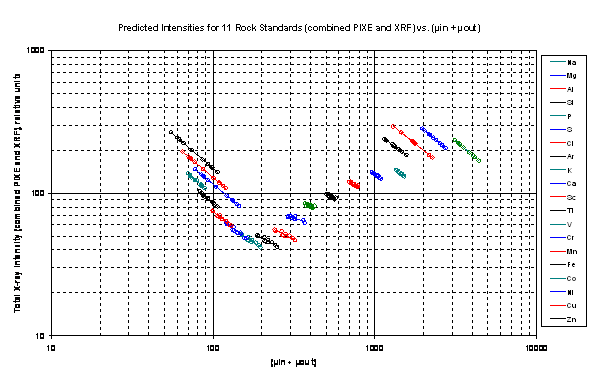
Fig. 4: Predicted x-ray yields for combined excitation by
alpha-particles and x-rays from 244Cm sources in
the 11 rock standards used for cross calibrations between
the flight instruments and the lab-reference instrument.
This was to be expected for all cases, where x-ray
excitation predominates (e.g. Fe). Here, exp
‑(µin*d) describes the production of
x-rays in depth d in the sample by the incoming
radiation, and exp ‑(µout*d) the
attenuation of the outgoing radiation from depth d
in the sample. Integration for an infinitely thick sample
(from d = 0 to d = ∞) then yields the above form. It
was, however, at first a surprise that this form is also
applicable to cases, where alpha excitation predominates.
The explanation is that in these cases (Na through ~ Ca)
µout is much larger than
µin, which means that only x‑rays
generated in a very shallow layer (1 to 5 µm) can
penetrate to the surface. As this layer is also much
thinner than the range of alpha particles (~ 30 µm),
the decrease of production with depth is small and the
dominant factor is µout. When applying
these matrix-factors to the measured intensities
(peak area intensities obtained from the deconvolution of
the spectra), we expected to find a linear relationship
between corrected intensities and concentrations. For most
samples this is indeed the case. There are, however,
outliers that we have not yet fully understood. The
most obvious reason is that the above assumptions -
homogeneous matrix, smooth surface, and well defined
entrance- and exit-angles - are certainly not true. In
particular, the assumption of homogeneity may be grossly
misleading, when certain elements only occur in certain
mineral phases, and we have evidence that this is indeed
the case for, e.g. phosphorus, which is known to
predominantly reside in apatite, and for which
matrix-corrected intensities show poorer correlations with
true concentrations than uncorrected intensities.
After the behaviour of phosphorus had become apparent, a
pragmatic approach was taken to include such effects: all
standards have been subject to a least squares analysis, by
which a linear relationship between true
concentrations and a combination of matrix-corrected and
uncorrected intensities of the form {x * corrected + (1-x)
* uncorrected} was investigated, which yielded specific
values of (0 < x < 1) for each element that appear
plausible in the light of their mineralogical occurrences.
For samples measured to date this pragmatic approach of
matrix correction has been applied.
Ultimately, the composition of a sample is derived by
converting results for individual elements into
stoechiometric oxides (in this case Fe is converted to FeO;
if Mößbauer data on the ratio of
Fe2+/Fe3+ are available, this can be
refined to properly partition Fe between FeO and
Fe2O3) and calculating closure to 100
%, neglecting possibly present invisibles, like
H2O and CO2. This is done iteratively
until convergence is obtained, and also yields information
about the geometry (distance), in which the sample was
measured.
Work in
Progress
In the meantime, work continues at the University of Guelph
on a more sophisticated model calculation, and first
results look very promising: most importantly (and
encouragingly), the differences in reduced data obtained by
the more sophisticated models and the pragmatic model
described above, turn out to be quite small. The more
sophisticated model may, however, lend itself to the
inclusion of more elaborate algorithms that could
eventually include a breakdown of samples into normative
minerals and a detailed computation of matrix effects in a
mix of different matrices. Another issue to be handled by
this model concerns the estimation of invisibles, in
particular water, from the evaluation of the elastic and
inelastic scatter peaks of the exciting x-ray lines. It is
anticipated that this model will be completed and tested by
the end of 2005, at which time all data (both from
calibration standards and from samples on Mars) will be
reprocessed and published as - hopefully - final results.
One last Comment
Readers, familiar with the problems encountered in XRF
analysis of powder samples, may be surprised by the
performance of the APXS - in particular with respect to
light elements, like Na, Mg, Al and Si. It appears that
when using alpha-particles for excitation, paired with a
careful calibration, the APXS can render results of a
quality far superior to the commonly adopted notion of a
qualitative, at best semi-quantitative nature
of such analyses.
References
[1] R. Rieder, R. Gellert, J. Brückner, G.
Klingelhöfer, G. Dreibus, A. Yen, and S. W. Squyres,
JOURNAL OF GEOPHYSICAL RESEARCH, VOL. 108, NO. E12, 8066,
2003
[2] Research Institute of Atomic Reactors of the
Russian Federation (RIAR) in Dimitrovgrad, Russia;
http://www.niiar.ru/
[3] Ketek GmbH, Munich; http://www.ketek.net/
[4] F. James, M. Roos: MINUIT Handbook, CERN,
Version 89.12 j; http://wwwasdoc.web.cern.ch/wwwasdoc/minuit/minmain.html
[5] YLD is a modified version of the PIXE-yield
program GUYLS, which is part of the program package for
PIXE analysis - GUPIX - available from the University of
Guelph;
http://pixe.physics.uoguelph.ca/gupix/main/
XRFY is a program especially written for APXS
analysis by John Maxwell to predict x-ray yields from
excitation by discrete x-ray lines from radioisotopes.
Both codes will become available from the
University of Guelph as part of a comprehensive package
(GUPIX-APXS), especially developed for the analysis of APXS
data. This will also include a program for spectrum
deconvolution. Anticipated time of completion is end of
2005.

