1. General Description
1.1 Purpose
The Small Forces File (SFF) provides the following information:
-an estimate of the cumulative delta-V effect of thruster firing
-an estimate of the cumulative spacecraft mass loss due to the use of propellant (fuel and oxidizer) while firing thrusters
-an estimate cumulative on-times for each individual thruster
The file provides the accumulated value of these quantities since a specified start time which is normally set to the time of MESSENGER launch. The intent is for each file to present the running history of thruster firing events since the start of the mission. For generality, the capability to specify a start time (or T0) other than launch is provided.
1.2. Scope
This Software Interface Specification (SIS) is applicable for the MESSENGER spacecraft. It covers both "predict" and "reconstruction" situations.
There are two planned activities where the propulsion system will be used for MESSENGER: trajectory correction maneuvers (TCMs) which intentionally impart a delta-V to alter the spacecraft’s trajectory and commanded momentum dumps where thrusters are used to maintain spacecraft attitude while off-loading momentum from the reaction wheels. Momentum dumps do not intentionally impart a significant delta-V to the spacecraft, but a small residual delta-V will always be incurred whenever thrusters are fired since they are not perfectly balanced. The MESSENGER G&C system also has the capability to use thrusters autonomously to lower system momentum or for attitude control when 1 or more reaction wheels have failed or are otherwise unavailable. For either commanded or autonomous thruster use, the system should be configured to record appropriate telemetry from which the desired SFF information can be computed. The exception is mass flow rate during thruster firing. This is estimated by ground models maintained by the propulsion system engineers.
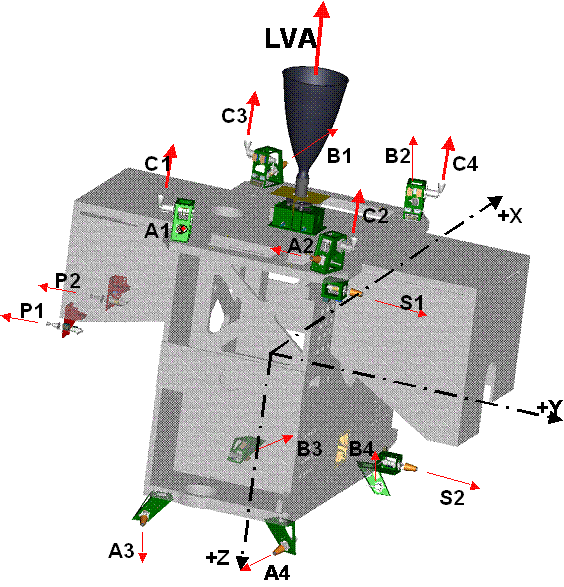
The MESSENGER propulsion system has 16 monopropellant thrusters, 12 4.4N thrusters designated A1-4, B1-4, S1 & 2, and P1 & 2 and 4 22N thrusters designated C1-4. There is also the LVA bi-propellant main engine which is used for very large delta-Vs, primarily Mercury Orbit Insertion (MOI). The location of each thruster is shown in Figure 1. There are two main fuel tanks and one oxidizer tank, all of the same size and one smaller auxiliary fuel tank. Mass flow rate depends on how many thruster of which type are firing and which set of fuel and/or oxidizer tanks are being used. There are 3 main propulsion system modes:
4.4N mono-prop thrusters are firing using the auxiliary tank. This mode is used for commanded and autonomous momentum dumps, TCMs with small delta-V targets, and for attitude control if too many wheels have failed.
22N mono-prop thrusters are firing using the main fuel tanks. This mode is used for TCMs with intermediate delta-V targets.
LVA bi-prop main engine is firing using fuel and oxidizer from the main fuel tanks. This mode is used for TCMs with large delta-V targets such as MOI and the DSMs.
Method of Generation
The SFF will be created either from simulations (predict mode) or from spacecraft telemetered data (reconstruction mode). Any SFF can contain a mixture of predicted or reconstructed data.
2.1 Predict Mode
From a specification standpoint, the predict record need only contain valid data for the first 10 fields. Thruster on-times are not mandatory. But, in order to provide the change in mass, some first-order estimate of the on-times will be needed.
2.2 Reconstruction Mode
An SFF may be produced in "reconstruction" mode by a set of scripts and programs that obtain data packets returned from the spacecraft and post-process and/or reformat this data into an SFF. This process includes some computations of derived parameters.
3. Detailed Data Object Definition
3.1 General Structure
An SFF consists of two sections–header and data–separated by an end of header character flag on a line by itself:
<header>
$$EOH
<data>
where
<header> is a set of KEYWORD=VALUE assignments
$$EOH is end-of-header delimiter, on a line by itself
<data> is one or more small forces data records
There is no special end of file marker inserted at the end of the data section.
3.2 Header Section Structure
The header section consists of the following KEYWORD=VALUE assignments, each on a line by itself. Any amount of white space, including none, can appear on each side of the "=" symbol.
MISSION_NAME = <character string>
SPACECRAFT_NAME = <character string>
DSN_SPACECRAFT_ID = <positive integer>
PRODUCTION_TIME = YYYY-MM-DD HR:MN:SC[.XXX]
PRODUCER_ID = <character string>
FILE_TYPE = SFF
START_TIME = YYYY-MM-DD HR:MN:SC[.XXX]
where
|
MISSION_NAME |
name of the mission (MESSENGER) |
|
SPACECRAFT_NAME |
name of the spacecraft (MSGR) |
|
DSN_SPACECRAFT_ID |
DSN ID for the spacecraft: (MESSENGER=236) |
|
PRODUCTION_TIME |
file production date and time, taken from the local computer clock |
|
PRODUCER_ID |
name/organization of the producer; example: JHU/APL |
|
FILE_TYPE |
always set to SFF to indicate that this is a small forces file |
|
START_TIME |
the “T0” time to which the deltaV and thruster on-time entries in all subsequent data records are referenced. Nominally this is set to the time of MESSENGER launch and not changed throughout the mission. The intent is for each SFF file to give a running history of constantly increasing accumulated deltaV and thruster on-times since the start of the mission. For flexibility and possible special applications, the software maintains the capability to change the start time to which all other records in a particular SFF are referenced. Note that while this is presented in a character string date/time format, it represents ET (ephemeris time) – not UTC or GMT. |
3.3 Data Section Structure
The data section of an SFF consists of one or more data records, each record occupying a single line:
<data record 1>
<data record 2>
...
<data record N>
Data Record Structure
Each SFF data record consists of the following 31 items given in the order shown:
INDEX, RECTYPE, GENTIM, TIME, MET,
DMASS, DVX, DVY, DVZ,
ESTQUAT1, ESTQUAT2, ESTQUAT3, ESTQUAT4,
PROP_MODE,
THRA1_TIME, THRA2_TIME, THRA2_TIME, THRA4_TIME,
THRB1_TIME, THRB2_TIME, THRB3_TIME, THRB4_TIME,
THRS1_TIME, THRS2_TIME, THRP1_TIME, THRP2_TIME,
THRC1_TIME, THRC2_TIME, THRC3_TIME, THRC4_TIME,
THRLVA_TIME
The first 8 items are required and will always be present for each record. The last 23 items are optional and may not all be present in a single record. Missing items are indicated by two consecutive commas separated by any amount of white space (blanks). The last item, item 31, is missing if there is nothing in the record following the last comma.
A short description of each data item is given in the table below; more detailed explanations for some items are provided in the text sections following the table/
|
INDEX |
Index of the record in the file (1...N) |
|
|
|
RECTYPE |
Type of the record, one
character string: P = predicted, R =
reconstructed, I = Intermediate |
|
|
|
GENTIM |
Record generation time; format: YYYY-MM-DD HR:MN:SC[.XXX]; taken from the local computer clock (implies UTC for TMOD computers) |
|
|
|
TIME |
Time tag for the record; format YYYY-MM-DD HR:MN:SC.XXX Given in a date/time character string format, but in the ET time frame (not UTC or GMT) |
|
|
|
MET |
Time tag given as spacecraft MET; if spacecraft attitude quaternion data is present, it is the estimated attitude at MET-1 second? |
|
|
|
MASS |
Total
mass decrement since the start time given in the header record (usually set
to launch), given in kg. This is computed from estimated mass flow rate
(parameter updated after each major maneuver) and either predicted or
reconstructed thruster on times. |
|
|
|
DVX |
Accumulated delta-V in EME2000 frame X direction since the start time given in the header record (usually set to launch), given in m/sec. |
|
|
|
DVY |
Accumulated delta-V in EME2000 frame Y direction since the start time given in the header record (usually set to launch), given in m/sec |
|
|
|
DVZ |
Accumulated delta-V in EME2000 frame Z direction since the start time given in the header record (usually set to launch), given in m/sec. |
|
|
|
ESTQUAT1 |
First element of the vector part of the quaternion giving
estimated spacecraft attitude at TIME or MET –1 second. |
|
|
ESTQUAT2 |
Second element of the vector part of the quaternion giving
estimated spacecraft attitude at TIME or MET – 1 second. |
|
|
ESTQUAT3 |
Third element of the vector part of the quaternion giving
the estimated spacecraft attitude at TIME or MET –1 second. |
|
|
ESTQUAT4 |
Scalar element of the quaternion giving the estimated
spacecraft attitude at TIME or MET – 1 second. |
|
|
PROP_MODE |
Propulsion system operational mode given as one of
the following integer codes: Mode 1 commanded event – TCM with small
delta-V or momentum dump using 4.4N mono-prop thrusters and auxiliary fuel
tank Mode 2 autonomous event – autonomous momentum
dump or attitude control using 4.4N mono-prop thrusters and auxiliary fuel
tank Mode 3 commanded TCM – intermediate delta-V
using 22N mono-prop thrusters and main fuel tanks Mode 4 commanded TCM – large delta-V using
LVA 660N main engine and main fuel and oxidizer tanks |
|
|
THRA1_TIME |
Cumulative on-time for thruster 0 (A1) since the start
time given in the header record, given in seconds |
|
|
THRA2_TIME |
Cumulative on-time for thruster 1 (A2) since the start
time given in the header record, given in seconds. |
|
|
THRA3_TIME |
Cumulative on-time for thruster 2 (A3) since the start
time given in the header record, given in seconds. |
|
|
THRA4_TIME |
Cumulative on-time for thruster 3 (A4) since the start
time given in the header record, given in seconds. |
|
|
THRB1_TIME |
Cumulative on-time for thruster 4 (B1) since the start
time given in the header record, given in seconds. |
|
|
THRB2_TIME |
Cumulative on-time for thruster 5 (B2) since the start
time given in the header record, given in seconds. |
|
|
THRB3_TIME |
Cumulative on-time for thruster 6 (B3) since the start
time given in the header record, given in seconds. |
|
|
THRB4_TIME |
Cumulative on-time for thruster 7 (B4) since the start
time given in the header record, given in seconds. |
|
|
THRS1_TIME |
Cumulative on-time for thruster 8 (S1) since the start
time given in the header record, given in seconds. |
|
|
THRS2_TIME |
Cumulative on-time for thruster 9 (S2) since the start
time given in the header record, given in seconds. |
|
|
THRP1_TIME |
Cumulative on-time for thruster 10 (P1) since the start
time given in the header record, given in seconds. |
|
|
THRP2_TIME |
Cumulative on-time for thruster 11 (P2) since the start
time given in the header record, given in seconds. |
|
|
THRC1_TIME |
Cumulative on-time for thruster 12 (C1) since the start time
given in the header record, given in seconds. |
|
|
THRC2_TIME |
Cumulative on-time for thruster 13 (C2) since the start
time given in the header record, given in seconds. |
|
|
THRC3_TIME |
Cumulative on-time for thruster 14 (C3) since the start
time given in the header record, given in seconds. |
|
|
THRC4_TIME |
Cumulative on-time for thruster 15 (C4 since the start
time given in the header record, given in seconds. |
|
|
THRLVA_TIME |
Cumulative on-time for thruster 16 (LVA) since the start
time given in the header record, given in seconds. |
|
RECTYPE
- an intermediate record is a record that was generated based solely on the
available telemetry at the time the record was generated. These records will eventually be manually
edited once the analysis is complete and marked 'R' (reconstructed). A record marked 'I' is subject to change,
while a record marked 'R' should be considered final.
EST_QUAT1,2,3,4:
Spacecraft attitude is provided in the form of a quaternion
specifying the orientation of the spacecraft body frame relative to the EME2000
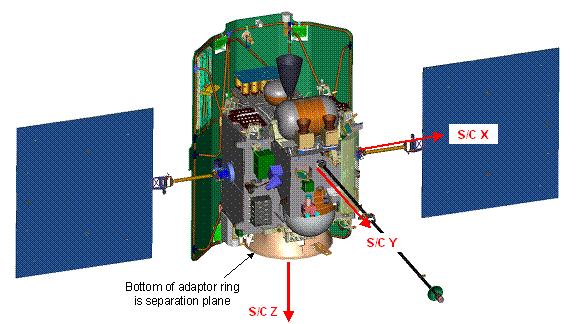
inertial reference frame. The MESSENGER s/c body frame is shown in Figure 2.
The quaternion specifies an axis of rotation and the angle of rotation about
that axis that is needed to transform from EME2000 to the s/c body frame. The
first 3 elements represent the rotation axis as a unit vector,  , multiplied by the cosine of ½ of the rotation angle,
  . The fourth element represents the sine of ½ of the rotation
angle. The quaternion is always unitized so that the sum of the squares of its
four elements equals 1.
. The fourth element represents the sine of ½ of the rotation
angle. The quaternion is always unitized so that the sum of the squares of its
four elements equals 1.
THRXX_TIME (XX = A1,A2, … LVA):
The MESSENGER G&C software tracks thruster on-times as a running count of 0.02 sec cycles that the thruster was commanded on by the software (control task runs at 50 Hz).
DVX,Y,Z:
The MESSENGER G&C software computes accumulated delta-V from accelerometer data. This is provided in the inertial reference frame (EME2000) in units of m/sec. It uses a constant s/c mass value to convert sensed acceleration to delta-V.
MASS:
This field shall now report the current spacecraft mass (at MET), instead of the delta mass. For intermediate records, there will be no ground modeling of mass flow rate to provide an estimated change in mass. Therefore, intermediate records will report the predicted mass. For autonomous momentum dumps, the intermediate record will report no change in mass.
|
|
Figure 1 Thruster Locations and Thrust Directions |
|
|
Figure 2 MESSENGER Spacecraft Body Coordinate Frame |