1. Introduction
1.1. Purpose and Scope
This Archive Volume Software Interface Specification is intended to be used by those who wish to understand the format and content of the science data archive generated by the Compact Reconnaissance Imaging Spectrometer for Mars (CRISM) instrument on the Mars Reconnaissance Orbiter (MRO) mission. Typically, these individuals would be software engineers, data analysts, or planetary scientists.
The specifications in this document apply to all CRISM standard product archive volumes that are released by the MRO Project.
|
Data Set |
Abbreviation |
Contents |
|
Experiment Data Record and Calibration Data Record |
EDR |
Raw data from the telemetry stream rearranged but unmodified except for lossless decompression. |
|
CDR |
Derived values needed to convert a scene-viewing EDR into units of radiance. |
|
|
Derived Data Record |
DDR |
A companion file for each EDR or TRDR pointed at Mars's surface that contains physical parameters such as latitude, longitude, and incidence, emission, and phase angle. Used for map projection, photometric correction, and to locate correction information in an ADR. |
|
Limb Data Record |
LDR |
A companion file for each EDR or TRDR pointed at Mars's limb that contains physical parameters such as latitude, longitude, and incidence, emission, and phase angle. Used to locate measurement tangent relative to the surface and model the radiance. |
|
Targeted Reduced Data Record |
TRDR |
Image data from an EDR converted to units of radiance or I/F using CDRs. A TRDR also contains a set of derived spectral parameters (summary products) that provide an overview of the data set. |
|
Ancillary Data Record |
ADR |
Reference information used to correct scene measurements for photometric, thermal emission, or atmospheric effects. |
|
Multispectral Reduced Data Record |
MRDR |
One of many tiles that make up a global mosaic, an MRDR contains map-projected VNIR+IR multispectral data from selected wavelengths, in units of I/F (extracted from TRDRs), Lambert albedo, summary products, and the DDR data used to generate them. |
|
VNIR Hyperspectral Reduced Data Record |
VRDR |
One of many tiles that make up a global mosaic, a VRDR contains map-projected VNIR hyperspectral data from one or more groups of contiguous wavelengths, in units of Lambert albedo, summary products, and the DDR data used to generate them. |
|
Targeted Empirical Record |
TER |
A spatially reconciled, full spectral range I/F targeted observation central scan image cube in the IR (L-detector) sensor space that has been corrected for geometric, photometric, atmospheric, and instrumental effects. |
|
Map-Projected Targeted Reduced Data Record |
MTRDR |
Similar in concept to an MRDR, MTRDRs are map-projected versions of TER data products. |
|
Data Set |
Abbreviation |
Data Set ID |
|
Experiment Data Record and Calibration Data Record |
EDR |
MRO-M-CRISM-2-EDR-V1.0 |
|
CDR |
MRO-M-CRISM-4/6-CDR-V1.0 |
|
|
Derived Data Record |
DDR |
MRO-M-CRISM-6-DDR-V1.0 |
|
Limb Data Record |
LDR |
MRO-M-CRISM-6-LDR-V1.0 |
|
Targeted Reduced Data Record and Ancillary Data Record |
TRDR |
MRO-M-CRISM-3-RDR-TARGETED-V1.0 |
|
ADR |
MRO-M-CRISM-6-ADR-V1.0 |
|
|
Multispectral Reduced Data Record |
MRDR |
MRO-M-CRISM-5-RDR-MULTISPECTRAL-V1.0 |
|
VNIR Hyperspectral Reduced Data Record |
VRDR |
MRO-M-CRISM-5-RDR-VNIRHYPERSPECTRAL-V1.0 |
|
Targeted Empirical Record |
TER |
MRO-M-CRISM-4-RDR-TARGETED-V1.0 |
|
Map-Projected Targeted Reduced Data Record |
MTRDR |
MRO-M-CRISM-5-RDR-MPTARGETED-V1.0 |
1.2. Content Overview
The CRISM Archive contains the raw data products, calibrated data products, derived data products, and ancillary products listed in Table 1-1. The products are described in detail in the CRISM Data Product SIS (Applicable Document 3 below). The CRISM Science Team and the Planetary Data System (PDS) Geosciences Node work together to assemble the CRISM archive volumes as specified in the CRISM – Geosciences Node ICD (Applicable Document 4 below).
This Archive Volume Software Interface Specification (SIS) describes the format and content of the CRISM Archive. Section 2, Archive Volume Structure, describes the overall structure of a CRISM archive volume. Section 3, Archive Volume Contents, describes the contents of each directory and file in the archive. Section 4, Archive Volume Format, describes the file formats used on the archive volumes. Finally, Section 5, Support Staff and Cognizant Persons, lists the individuals responsible for generating the archive volumes.
1.3. Applicable Documents and Constraints
This Archive Volume SIS is intended to be consistent with the following documents:
1. Mars Exploration Program Data Management Plan, R. E. Arvidson et al., Rev. 3.0, March 20, 2002.
2. Mars Reconnaissance Orbiter (MRO) Project Data Archive Generation, Validation, and Transfer Plan, R.E. Arvidson et al., JPL D-22246.
3. Mars Reconnaissance Orbiter CRISM Data Product Software Interface Specification, v. 1.3.7.6, March 1, 2023.
5. Planetary Data System Archive Preparation Guide (APG), R. Beebe, January 20, 2005.
6. Planetary Data System Standards Reference, June 15, 2001, Version 3.4. JPL D-7669, Part 2.
1.4. Relationships with Other Interfaces
This Archive Volume SIS could be affected by changes to the design of the CRISM standard data products (Applicable Document 3). Although every attempt is made to make the two documents consistent, this one takes precedence on issues of archive structure whereas the Data Products SIS (Applicable Document 3) takes precedence in issues of archive content.
This Archive Volume SIS could be affected by changes to the PDS standards regarding the contents of archive volumes, in particular the placement of data dictionary files in the DOCUMENT directory.
2. Archive Volume Structure
This section describes the overall structure of all CRISM archive volumes.
The CRISM archive is available online via Web and FTP servers. This is the primary means of distribution. Therefore, the archive is organized as a set of virtual volumes, with each data set stored online as a single volume. As new data products are released they are added to the volume's data directory, and the volume's index table is updated accordingly. The size of the volume is not limited by the capacity of the physical media on which it is stored; hence the term virtual volume.
When it is necessary to transfer all or part of a data set to other media such as DVD for distribution or for offline storage, the virtual volume's contents are written to the other media according to PDS policy, possibly dividing the contents among several physical volumes.
The following volume identifiers are assigned to CRISM data sets by the Planetary Data System. These identifiers are unique among all PDS data sets.
Table 2-1. CRISM Data Sets and Volume IDs
|
Data Set |
Volume ID |
|
Experiment Data Record and Calibration Data Record |
USA_NASA_APL_MROCR_0nnn |
|
Derived Data Record |
USA_NASA_APL_MROCR_1nnn |
|
Targeted Reduced Data Record and Ancillary Data Record |
USA_NASA_APL_MROCR_2nnn |
|
Multispectral Reduced Data Record |
USA_NASA_APL_MROCR_3nnn |
|
Map-Projected Targeted Reduced Data Record |
USA_NASA_APL_MROCR_4nnn |
|
Limb Data Record |
USA_NASA_APL_MROCR_5nnn |
|
Targeted Empirical Record |
USA_NASA_APL_MROCR_6nnn |
|
VNIR Hyperspectral Reduced Data Record |
USA_NASA_APL_MROCR_7nnn |
Each CRISM archive volume contains at minimum the following directories below the root directory:
· DATA (may be named EDR, CDR, etc. based on product type)
· INDEX
· DOCUMENT
· CATALOG
· LABEL
In addition to these, a CRISM archive volume may include other directories:
· CALIB
· GEOMETRY
· BROWSE
· EXTRAS
Section 3 describes the contents and required files for each directory.
3. Archive Volume Contents
This section describes the contents of the CRISM Archive volumes, including the file names, file contents, file types, and organization responsible for providing the files. The indication that a file is required means that it is required by the PDS standards for archive volumes, as specified in the PDS Standards Reference, Applicable Document 6.
3.1. Root Directory Contents
Files in the Root Directory include an overview of the archive, a description of the volume for the PDS Catalog, and a list of errata or comments about the archive. The following files are contained in the Root Directory.
Table 3-1. Root Directory Contents
|
File Name |
Required? |
File Contents |
File Provided By |
|
AAREADME.TXT |
Yes |
Volume content and format information |
Geosciences |
|
ERRATA.TXT |
No |
A cumulative listing of comments and updates concerning all archive volumes published to date |
Geosciences and CRISM |
|
VOLDESC.CAT |
Yes |
A description of the contents of this volume in a PDS format readable by both humans and computers |
Geosciences |
3.2. Data Directory Contents and File Naming
Files in the data directory may contain
· raw data in unit of DN
· coefficients needed to calibrate the data
· non-resampled calibrated data in units of radiance, I/F, or unitless spectral parameters
· map-projected I/F, Lambert albedo, or unitless spectral parameters
· observation geometry, coordinates, or surface physical properties in sensor space used for correction from radiance to I/F, either in sensor space or map projected
The descriptions below are intended to provide a synopsis of the contents of the data directory. Users are referred to the CRISM Data Products SIS (Applicable Document 3) for a more detail description of the formats, contents, and derivation of data products.
Contents of data directories evolved over time as: (a) new CRISM operating modes were introduced after completion of MRO’s 2-year Primary Science Phase; (b) the gimbal aged and in. 2012 lost mobility over part of its range, leading revision of the layout of targeted observations; and (c) performance of the cryocoolers degraded leading eventually to cessation of usage of the infrared (IR) detector and increasing usage of visible/near-infrared- (VNIR-) only modes. The data ranges (beginning 2006) of pedigree of files in the data directories are given below in section. 3.2.1.
3.2.1. EDR Directory
The EDR directory is present in the EDR archive volume. It contains CRISM visible and near infrared (VNIR) and infrared (IR) EDRs and information on data validation.
An EDR consists of a part or all of the output from one of the constituent command macros that make up one observation tagged by a unique observation ID. The data in one EDR represent a consistent instrument configuration (shutter position, frame rate, pixel binning, compression, exposure time, on/off status and setting of different lamps). This is shown schematically in Figure 3-2. There is a single multiple-band image (suffix *.IMG) stored in one file, plus a detached list file in which each record has information specific to one frame of the multiple-band image (suffix *.TAB). One label points to both files.
The multiple-band image has dimensions of sample, line, and wavelength. The size of the multiple-band image varies according to the observation mode but is deterministic given the macro ID, as described in Data Products SIS. Pixels are 16-bit unsigned integer values, most significant bit first. Appended to the multiple-band image is a binary table of the detector rows that were used, as selected by the wavelength filter. This is a one-column table, with each row containing one detector row number expressed as a 16-bit unsigned integer values, most significant bit first.
The detached comma-separated ASCII file contains raw instrument housekeeping plus other frame-dependent information, one row per detector frame.

Figure 3-2. Contents of a CRISM Experiment Data Record (EDR).
EDRs are organized into subdirectories by year and day of year (DOY), e.g. 2006/2006_350. An EDR is assigned to a directory based on the start time of the observation with which an EDR is associated. Several EDRs may result from one observation, and all share a common observation ID. These EDRs are grouped into subdirectories within a YYYY_DDD subdirectory, named for the combination of class type and observation ID unique to a single observation (e.g. "FRT00001270").
In each subdirectory containing the EDRs for a single observation, there is also a text report on data validation for the EDRs generated by each detector.
The file naming convention for an EDR is as follows. See the CRISM Data Products SIS for the significance of each field in the file name.
(ClassType)(ObsID)_(Counter)_ (Activity)(SensorID)_(Filetype)(version).(Ext)
where:
ClassType =
FRT (Full Resolution Targeted Observation; discontinued 2012)
HRL (Half Resolution Long Targeted Observation; discontinued 2012)
HRS (Half Resolution Short Targeted Observation; discontinued 2012)
FRS (Full Resolution Short Targeted Observation; initiated 2012)
ATO (Along-Track Oversampled Targeted Observation; initiated 2011)
ATU (Along-Track Undersampled Targeted Observation; initiated 2012)
EPF (Atmospheric Survey EPF; discontinued 2012)
LMB (Limb Scan Observation; initiated 2009, discontinued 2017)
TOD (Tracking Optical Depth Observation; initiated 2007, discontinued 2017)
MSP (Multispectral Survey; discontinued 2018)
HSP (Hyperspectral Survey; initiated 2010, discontinued 2018)
HSV (Hyperspectral Survey - VNIR only, pixels 10x-binned; initiated 2010)
MSV (Hyperspectral Survey - VNIR only, pixels 5x-binned; initiated 2012)
MSW (Multispectral Window; discontinued 2008)
FFC (Flat Field Calibration)
CAL (Radiometric Calibration)
ICL (Calibration source intercalibration)
STO (Star Observation)
FUN (Functional test)
UNK (no valid EDRs within observation that indicate class type)
ObsID = nnnnnnnn, Observation ID, unique for the whole CRISM mission, expressed as a hexadecimal number
Counter = nn, a monotonically increasing ordinal counter of EDRs from one Observation ID, expressed as a hexadecimal number
Activity = for an EDR, type of observation, e.g.
BInnn – Bias measurements / Macro#
DFnnn – Dark field measurements / Macro#
LPnnn – Lamp measurements / Macro #
SPnnn – Sphere measurements / Macro #
SCnnn – Scene measurements / Macro #
T1nnn – Focal plane electronics test pattern 1 / Macro #
T2nnn – Focal plane electronics test pattern 2 / Macro #
T3nnn – Focal plane electronics test pattern 3 / Macro #
T4nnn – Focal plane electronics test pattern 4 / Macro #
T5nnn – Focal plane electronics test pattern 5 / Macro #
T6nnn – Focal plane electronics test pattern 6 / Macro #
T7nnn – Focal plane electronics test pattern 7 / Macro #
UNnnn – Instrument configuration does not match macro library / Macro #
SensorID = S for VNIR, or L for IR
Filetype = EDR
version = 0, 1,...,9, a, ..., z
Ext = IMG or TAB
The file naming convention for the validation report is as follows.
(ClassType)(ObsID)_(SensorID)_VALIDATION.TXT
3.2.2. CDR Directory
The CDR directory is also present in the EDR archive volume. It contains calibration files (Figures 3-3 and 3-4) used to process EDRs to units of radiance or I/F. More detailed information on the contents of these files can be founding the in CRISM Data Products SIS.

|
Figure 3-3. Contents of a CRISM level 4 Calibration Data Record (CDR). |
Figure 3-4. Contents of a CRISM level 6 Calibration Data Record (CDR). |
There are two formats of CDRs. A level-6 CDR (Figure 3-4) consists of tabulated derived data needed for calibration to radiance or I/F. The different types of level-6 CDRs are given in Table 3-5. A level-4 CDR (Figure 3-3) consists of a derived image product needed for calibration to radiance or I/F. The different types of level-4 CDRs are given in Table 3-6.
The file naming convention for level-6 CDRs is as follows.
(ProductType)(Level)_(Partition)_(Time)_(Product)_(SensorID)_version.(Ext)
where:
ProductType = CDR
Level = 6
Partition = n, partition of the spacecraft clock.
Time = nnnnnnnnnn, spacecraft start time of applicability of data product; units are spacecraft clock counts, in units of whole seconds.
Product = nn, acronym describing data product from Table 3-5
SensorID = S or L (or J=joint)
Version = 0, 1,..., 9, a,..., z
Ext = TAB
Also classified as level 6 CDRs are tables that contain sets of scene EDRs with the accompanying calibration EDRs needed for their calibration. These tables are used by software that processes the EDRs into CDRs or TRDRs. The file naming convention for these tables is as follows; it is different from the rest of the CDR6s to distinguish them from data-containing files.
(Product)_(Sensor)_(YYYY)_(DOY)_version
where:
Product Type = BTF for before-the-fact predicted, or ATF for after-the-fact actual
Sensor = VN or IR
YYYY = year
DOY = day of year
Version = nn
The file naming convention for level-4 CDRs is as follows.
(ProductType)(Level)(Partition)(Time)_ (Product)(FrameRate)(Binning)(ExposureParameter)(WavelengthFilter)(Side)(SensorID)_ version.(Ext)
where:
Product Type = CDR
Level = 4
FrameRate = n, rate in Hz at which data are taken (0=1 Hz, 1=3.75 Hz, 3=15 Hz, 4=30 Hz, 5 = N/A)
Binning = n, number of spatial pixels binned (0=unbinned, 1= 2x binned, 2= 5x binned, 3= 10x binned, 4=N/A)
Exposure parameter = nnn, an integer 1-480 indicating commanded exposure time in units of (inverse frame rate)/480; 000 if inapplicable
Wavelength filter = n, and integer 0-3 indicating which onboard menu of rows of the detector are represented
Side = #, 1 or 2 for focal plane or sphere bulbs; or 0 if N/A
Ext = IMG
CDRs are arranged into directories based on how frequently they are updated. Files that are either invariant or expected to change only infrequently are stored in directories named using a 2-letter acronym for the product type. Files that are highly time-variable, for example the thermal background measured by the IR detector, are stored in directories named YYYY_DOY, each of which contains subdirectories named using the 2- or 3-letter acronym for the product type.
Table 3-5. Descriptions of level-6 CDRs
|
PRODUCTS |
FORM FOR EACH FOCAL PLANE |
PRODUCT ACRONYM |
|
INFREQUENTLY UPDATED PRODUCTS |
||
|
Coefficients for correcting raw housekeeping for effects of lamps, coolers, frame rate |
ASCII table , 11 columns (only one file applicable to both VNIR and IR) |
HD |
|
Coefficients for calibrating housekeeping from digital to physical units |
ASCII table , 5 columns (only one file applicable to both VNIR and IR) |
HK |
|
Coefficients to convert housekeeping voltages for perturbations due to current |
ASCII table , 7 columns (only one file applicable to both VNIR and IR) |
HV |
|
Gain and offset to use for each row for 12 to 14 bit conversion; 12 to 8 bit lookup tables used for each row |
ASCII table, 4 columns, 1 per detector |
PP |
|
Wavelength tables |
ASCII table, 5 columns, 1 per detector |
WV |
|
Bandwidth for each row (band) in central columns of each detector at which spectral smile and keystone are minimum. |
ASCII table, 2 cols VNIR and 11 cols IR, 1 per detector |
BW |
|
Center wavelength for each row (band) in central columns of each detector at which spectral smile and keystone are minimum. |
ASCII table, 2 columns, 1 per detector |
SW |
|
12 to 8 bit lookup tables |
ASCII table, 1 col. of 12-bit input, 8 cols. of 8-bit output |
LK |
|
8 to 12 bit lookup tables (inverse of 12 to 8) |
ASCII table, 8 cols. of 8-bit input, 1 col. of 12-bit output |
LI |
|
Linearity correction |
ASCII table, 7 columns, 1 per detector |
LC |
|
Bias step function as a function of frame rate and quadrant |
ASCII table, 3 columns, 1 per detector |
BS |
|
Additive correction of bias to nominal detector operating temperature |
ASCII table, 3 columns, 1 per detector |
DB |
|
Additive correction of bias to nominal focal plane electronics operating temperature |
ASCII table, 3 columns, 1 per detector |
EB |
|
Interquadrant ghost removal scaling factors |
ASCII table, 6 columns, 1 per detector |
GH |
|
Average Mars spectrum for limiting cases in different operating modes |
ASCII table, 6 columns, 1 per detector |
AS |
|
Saturation limit for each detector quadrant and frame rate |
ASCII table, 3 columns, 1 per detector |
SL |
|
Valid limits for each detector quadrant and frame rate for 14-bit DN level and noise |
ASCII table, 5 columns, 1 per detector |
VL |
|
Atmospheric transmission for each wavelength bin averaged over IR columns 270-369 or VNIR columns 260-359, the part of each detector at which spectral smile and keystone are minimum |
ASCII table, 2 columns, 1 per detector |
CT |
|
FREQUENTLY UPDATED PRODUCTS |
||
|
Standard telemetry file: CRISM low-rate telemetry in raw counts, from the beginning of a UTC calendar day to its end. This is used in preference to the telemetry attached to each image for correction of thermal effects. |
ASCII table, 224 columns |
ST |
|
Predicted EDR processing table: Predicted table of EDRs containing scene data and the corresponding EDRs containing time-dependent calibration measurements. It is constructed from uplinked commands |
ASCII table, 21 columns |
BTF |
|
EDR processing table: Table of EDRs containing scene data and the corresponding EDRs containing time-dependent calibration measurements. Used to process scene EDRs to TRDRs, and calibration EDRs to CDRs. If there is a discrepancy between the actual and predicted EDRs used for calibration, the TRDRs resulting from scene EDRs are quality-flagged. |
ASCII table, 6 columns |
ATF |
Table 3-6. Descriptions of level-4 CDRs
|
PRODUCTS |
FORM FOR EACH FOCAL PLANE |
VERSIONS FOR DIFFERENT PIXEL BINNING / CHANNEL SELECTION? |
VERSIONS FOR DIFFERENT FRAME RATE? |
ACRONYM |
|
GROUND CALIBRATION PRODUCTS |
||||
|
Masks of detector dark columns, scattered light columns, scene columns |
2D matrix per detector, 8 bit |
Y |
N |
DM |
|
Nonuniformity file: time-tagged, rown-normalized measurement of detector nonuniformity |
Two 2D matrices, 32 bit |
Y |
Y |
NU |
|
Matrices to remove estimated leaked higher order light |
Four 2D matrices per detector, 16 bit integer, row numbers
Four 2D matrices per detector, 32 bit, weighting coefficients |
Y |
N |
LL |
|
Sphere spectral radiance at set point (pixel by pixel coefficients to a 2nd order polynomial function of optical bench temperature) |
Three 2D matrices per detector, 32 bit, for each sphere bulb |
Y |
N |
SS |
|
Shutter position reproducibility correction to sphere radiance (pixel by pixel coefficients to a linear function of the ratio of corrected sphere image to sphere spectral radiance model) |
2 2D matrices per detector, 32 bit, for each sphere bulb |
Y |
N |
SH |
|
Temperature dependence of detector responsivity (pixel by pixel coefficients to a 2nd order polynomial function of detector temperature) |
Three 2D matrices per detector, 32 bit |
Y |
N |
TD |
|
Along-slit angle measured from slit center |
2D matrix per detector, 32 bit |
Y |
N |
CM |
|
Number of lines by which to shift each column (sample) of an image to minimize the effects of spectral smile |
2D matrix per detector, 32 bit |
Y |
N |
PS |
|
Wavelength image (each pixel) determined onground |
2D matrix per detector, 32 bit |
Y |
N |
WA |
|
Nearest-neighbor resampled wavelength image (each pixel) determined onground |
2D matrix per detector, 32 bit |
Y |
N |
RW |
|
Spectral bandpass, or full width half maximum (each pixel) determined onground |
One (VNIR) or ten(IR) 2D matrices per detector, 32 bit |
Y |
N |
SB |
|
Solar flux at 1 AU (for each pixel to take into account spectral smile effects) |
2D matrix per detector, 32 bit |
Y |
N |
SF |
|
Nearest-neighbor resampled solar flux at 1 AU (for each pixel to take into account spectral smile effects) |
2D matrix per detector, 32 bit |
Y |
N |
RF |
|
Atmospheric transmission as measured from a nadir-pointed hyperspectral scan across Olympus Mons |
2D matrix per detector, 32 bit |
Y |
N |
AT |
|
Atmospheric transmission as measured from a nadir-pointed hyperspectral scan across Olympus Mons, nearest-neighbor resampled in the wavelength direction |
2D matrix per detector, 32 bit |
Y |
N |
RT |
|
FREQUENTLY UPDATED PRODUCTS |
|||||
|
Bad pixel mask: time-tagged bitmap of bad pixels |
2D matrix, 8 bits, per detector |
Y |
Y |
BP |
|
|
Bias file: time-tagged, fitted VNIR and IR images extrapolated to zero exposure time |
2D matrix, 32 bit, per detector |
Y |
Y |
BI |
|
|
Background file: time-tagged, bias- and ghost-subtracted, linearized, averaged VNIR and IR background frames |
2D matrix, 32 bit, per detector |
Y |
Y |
BK |
|
|
Noise file: time-tagged, image of pixel-by-pixel uncertainties in background images |
2D matrix, 32 bit, per detector |
Y |
Y |
UB |
|
|
Processed sphere image in units of DN/ms |
2D matrix, 32 bit, per detector (1 for each sphere bulb) |
Y |
N |
SP |
|
3.2.3. DDR Directory
The DDR directory is present in the DDR archive volume. It contains CRISM VNIR and IR Derived Data Records (DDRs) for observations pointed at Mars' surface, which include information needed to map project data calibrated to units of radiance or I/F, or to process them further to Lambert albedo corrected for photometric, atmospheric, and thermal effects.
There are two types of information in DDRs: geometric information (latitude, longitude, incidence, emission, and phase angles, and local solar time) and information on surface physical properties (elevation, slope magnitude and azimuth, bolometric albedo, and thermal inertia). The geometric information is derived from pixel spatial coordinates and the SPICE files in the GEOM directory. The physical information is derived by retrieving information from other data sets for the latitudes and longitudes corresponding to each detector element, and thus is in non-resampled sensor space.
As shown in Figure 3-7, a DDR contains a single multiple-band image. It has the same spatial dimensions as a scene EDR or the resulting TRDR. The size of the multiple-band image varies according to the observation mode but is deterministic given the macro ID. The data values are given in 32-bit real numbers. There is one DDR per VNIR TRDR or scene EDR, and one DDR per IR TRDR or scene EDR. Although there is a one-to-one correspondence between line and line_sample coordinates in a corresponding DDR, EDR containing planetary scene information (activity=SCnnn from section 3.2.1), and TRDR (section 3.2.5), the EDR and TRDR contain uncorrected optical distortions that change the spatial scale of the image with band. Therefore the DDR is referenced to a single band for each file, that nearest to 610 nm in the VNIR, or 2300 nm in the IR.
Once image data are assembled into EDRs and calibrated into TRDRs, DDRs are created for the data. A version 0 DDR represents values based on predicted pointing, and is generated to provide quick-look information. Version 1 and subsequent versions of a DDR are based on actual, reconstructed pointing.

Figure 3-7. Contents of a CRISM Derived Data Record (DDR).
For parallelism, DDRs are organized like EDRs and TRDRs into subdirectories by year and DOY, e.g. 2006/2006_350. A DDR is assigned to a directory based on the start time of the observation (observation ID) with which the DDR is associated. Multiple DDRs for a single observation are grouped into subdirectories within a YYYY_DDD subdirectory, named for the combination of class type and observation ID unique to a single observation (e.g. "FRT00001270").
The file naming convention for a DDR is as follows.
(ClassType)(ObsID)_(Counter)_ (Activity)(SensorID)_(Filetype)(version).(Ext)
where:
ClassType =
FRT (Full Resolution Targeted Observation)
HRL (Half Resolution Long Targeted Observation)
HRS (Half Resolution Short Targeted Observation)
FRS (Full Resolution Short Targeted Observation)
ATO (Along-Track Oversampled Targeted Observation)
ATU (Along-Track Undersampled Targeted Observation)
EPF (Atmospheric Survey EPF)
TOD (Tracking Optical Depth Observation)
MSP (Multispectral Survey)
HSP (Hyperspectral Survey, losslessly compressed)
HSV (Hyperspectral Survey - VNIR only, pixels 10x-binned)
MSV (Hyperspectral Survey - VNIR only, pixels 5x-binned)
MSW (Multispectral Window)
FFC (Flat Field Calibration)
ObsID = nnnnnnnn, Observation ID, unique for the whole CRISM mission, expressed as a hexadecimal number
Counter = nn, the ordinal counter carried through from the source EDR, expressed as a hexadecimal number
Activity = for a DDR, type of product,
DEnnn – Derived product / Macro#
SensorID = S or L
Filetype = DDR
version = 0, 1,...,9, a, ..., z
Ext = IMG
3.2.4. LDR Directory
The LDR directory is present in the LDR archive volume. It contains CRISM VNIR and IR Limb Data Records (LDRs) for observations scanned across Mars' limb, which include information on the tangent height of each pixel above Mars' surface and photometric angles to analyze the measured radiances. The geometric information is derived from pixel spatial coordinates and the SPICE files in the GEOM directory.
The structure of an LDR is similar to that of a DDR, containing a single multiple-band image. It has the same spatial dimensions as a scene EDR or the resulting TRDR. The data values are given in 32-bit real numbers. There is one LDR per VNIR TRDR or scene EDR, and one LDR per IR TRDR or scene EDR. Although there is a one-to-one correspondence between line and line_sample coordinates in a corresponding LDR, EDR containing planetary scene information (activity=SCnnn from section 3.2.1), and TRDR (section 3.2.5), the EDR and TRDR contain uncorrected optical distortions that change the spatial scale of the image with band. Therefore the LDR is referenced to a single band for each file, that nearest to 610 nm in the VNIR, or 2300 nm in the IR.
Once limb scan image data are assembled into EDRs, calibrated into TRDRs, and reconstructed pointing is available, LDRs are created for the data. There is no significance to the occurrence version number 0 or 1.
For parallelism, LDRs are organized like EDRs and TRDRs into subdirectories by year and DOY, e.g. 2006/2006_350. These subdirectories exist only for days on which limb scan observations were being taken. An LDR is assigned to a directory based on the start time of the observation (observation ID) with which the LDR is associated. Multiple LDRs for a single observation are grouped into subdirectories within a YYYY_DDD subdirectory, named for the combination of class type and observation ID unique to a single observation (e.g. "LMB00001270").
The file naming convention for an LDR is as follows.
(ClassType)(ObsID)_(Counter)_ (Activity)(SensorID)_(Filetype)(version).(Ext)
where:
ClassType =
LMB (Limb Scan Observation)
ObsID = nnnnnnnn, Observation ID, unique for the whole CRISM mission, expressed as a hexadecimal number
Counter = nn, the ordinal counter carried through from the source EDR, expressed as a hexadecimal number
Activity = for an LDR, type of product,
DEnnn – Derived product / Macro#
SensorID = S or L
Filetype = LDR
version = 0, 1,...,9, a, ..., z
Ext = IMG
3.2.5. TRDR Directory
The TRDR directory is present in the TRDR archive volume. It contains CRISM VNIR and IR Targeted Reduced Data Records (TRDRs), calibrated data in non-resampled sensor space. As with EDRs and DDRs, the TRDRs are organized into subdirectories by year and DOY, e.g. 2006/2006_350. A TRDR is assigned to a directory based on the start time of the observation (observation ID) with which the TRDR is associated. Multiple TRDRs from a single observation are grouped into subdirectories within a YYYY_DDD subdirectory, named for the combination of class type and observation ID unique to a single observation (e.g. "FRT00001270").
The TRDR consists of the output of one of the constituent macros associated with a target ID that contains scene data (Mars or other), as shown in Figure 3-8. Not all EDRs are processed to TRDR level; macros containing bias, background, sphere, or calibration lamp data are processed instead to CDRs (discussed in section 3.2.3).
The TRDR contains one or more multiple-band images (suffix *.IMG). One matches the dimensions of the multiple-band image of raw DN in an EDR, except that the data are in units of radiance. The size of the multiple-band image varies according to the observation mode but is deterministic given the ID of the command macro used to acquire the data. Appended to the multiple-band image is a binary table of the detector rows that were used, as selected by the wavelength filter. This is a one-column table, with each row containing one detector row number expressed as a 16-bit unsigned integer values, most significant bit first.
Other multiple-band images may contain I/F or Lambert albedo. The I/F and Lambert albedo images, if present, parallel the structure of the radiance image.
In any of the multiple-band images, data values are given in 32-bit real numbers.
Each TRDR also contains a detached list file (suffix *.TAB) analogous to that in the EDR, in which each record has information specific to one frame of the multiple-band radiance image, except that the analog status data are in physical units.
There is at least one label per TRDR. That label points to the radiance multiband image and the list file; additional labels may point to the I/F or Lambert albedo image.

Figure 3-8. Contents of a CRISM Reduced Data Record for a single observation (TRDR).
The file naming convention for a TRDR is as follows.
(ClassType)(ObsID)_(Counter)_ (Activity)(SensorID)_(Filetype)(version).(Ext)
where:
ClassType =
FRT (Full Resolution Targeted Observation)
HRL (Half Resolution Long Targeted Observation)
HRS (Half Resolution Short Targeted Observation)
FRS (Full Resolution Short Targeted Observation)
ATO (Along-Track Oversampled Targeted Observation)
ATU (Along-Track Undersampled Targeted Observation)
EPF (Atmospheric Survey EPF)
TOD (Tracking Optical Depth Observation)
LMB (Limb Scan Observation)
MSP (Multispectral Survey, losslessly compressed)
HSP (Hyperspectral Survey, losslessly compressed)
HSV (Hyperspectral Survey - VNIR only, pixels 10x-binned)
MSV (Hyperspectral Survey - VNIR only, pixels 5x-binned)
MSW (Multispectral Window)
FFC (Flat Field Calibration)
ObsID= nnnnnnnn, Observation ID, unique for the whole CRISM mission, expressed as a hexadecimal number
Counter= nn, the ordinal counter carried through from the source EDR, expressed as a hexadecimal number
Activity= for a TRDR, type of product, e.g.
RAnnn – Radiance / Macro#
SUnnn – Summary Products / Macro #
IFnnn – I/F / Macro #
ALnnn – Lambert albedo / Macro #
SensorID= S or L
Filetype = "TRR" for TRDR
version= 0, 1,...,9, a, ..., z
Ext= IMG or TAB
3.2.6. ADR Directory
The ADR directory may also present in the TRDR archive volume. An Ancillary Data Record or ADR contains a hyperdimensional binary table of derived values, where the axes of the matrix represent values of a layer of a DDR (e.g., incidence angle, thermal inertia, etc.), the output of another ADR, or a value extracted from a TRDR.
The overall objective of ADRs is to correct I/F in a TRDR for predictive atmospheric, photometric, or thermal effects to isolate the surface-reflected component of radiance as Lambert albedo. There are three types of ADRs:
1. The "CL" ADR is a table of climatologically predicted surface temperatures and atmospheric dust and ice opacities, given for a latitude and longitude from the DDR and Ls and local solar time from the TRDR label.
2. The "AC" ADR is a table of correction from I/F to Lambert albedo, for an incidence, emission, and phase angle and surface elevation from the DDR, dust and ice optical depths and surface temperature from the CL ADR, and observed I/F from a TRDR. There is a separate AC ADR for each wavelength that is corrected; nominal wavelengths are those used in multispectral mapping, in wavelength filter 1.
3. The "TE" ADR is a table of calculated surface temperature for latitude, thermal inertia, elevation, and slope magnitude and azimuth from the DDR, dust and ice opacity from the CL ADR, Ls and local solar time from the TRDR label, and bolometric albedo estimated from Lambert albedo at wavelengths <2300 nm. This supplants surface temperature that is returned from the CL ADR.
The file naming convention for ADRs is as follows.
(ProductType)_(ADR_Type)_(Wavelength)_(Partition)_(Time)_version.(Ext)
where:
Product Type = ADR
ADR_Type = nn, acronym in captions of Tables 3-9 to 3-11
Wavelength = nnnn, in nanometers; 0000 if not applicable
Partition = n, spacecraft clock partition.
Time = nnnnnnnnnn, spacecraft start time of applicability of data product; units are spacecraft clock counts, in units of whole seconds.
version = 0, 1,..., 9, a,..., z
Ext = DAT
Table 3-9. LUT for atmospheric opacity (ADR type = CL)
|
VARIABLE |
RANGE |
UNIT |
|
Latitude |
-90-90° |
degrees |
|
Longitude |
-90-90° |
degrees |
|
Ls |
0-360° |
degrees |
|
Local time |
15 |
(assumed local time)r |
|
Surface temperature |
180-310 |
°K |
|
Dust opacity |
0-1.0 |
dimensionless opacity |
|
Ice opacity |
0-1.0 |
dimensionless opacity |
Table 3-10. LUT for predicted atmospheric / photometric / thermal correction (ADR type = AC)
|
VARIABLE |
RANGE |
WAVELENGTH |
|
Wavelength |
410-3920 nm |
(separate table for each wavelength) |
|
Incidence angle at areoid |
25-75° |
degrees |
|
Emission angle at areoid |
0-45° |
degrees |
|
Phase angle at areoid |
45-135° |
degrees |
|
Elevation |
-8000-26000 |
meters |
|
Dust optical depth |
0-1 |
dimensionless opacity |
|
Ice optical depth |
0-0.6 |
dimensionless opacity |
|
Surface temperature |
140-300 K |
°K |
|
Observed I/F |
0.03-0.50 |
dimensionless |
Table 3-11. LUT for local surface temperature (ADR type = TE)
|
VARIABLE |
RANGE |
UNITS |
|
Latitude |
-90-90° |
degrees |
|
Slope magnitude |
0-10 |
degrees |
|
Slope azimuth |
0-270 |
degrees clockwise from north |
|
Elevation |
-8000-26000 |
meters |
|
Thermal inertia |
5-5000 |
J m^-2 K^-1 s^-0.5 |
|
Dust+ice opacity |
0-1.0 |
dimensionless opacity |
|
Ls |
0-360° |
degrees |
|
Local time |
13-17 |
(assumed local time) |
|
Bolometric albedo |
0.15-0.35 |
dimensionless |
3.2.7. MRDR Directory
The MRDR directory, present in the MRDR archive volume, contains CRISM Multispectral Reduced Data Records (MRDRs). The MRDRs are organized into 30 subdirectories named by the Mars Chart containing the MRDR, e.g. MC01. Latitude and longitude limits of Mars Charts are given in Table 3-12.
An MRDR (Figure 3-13) consists of several or more strips of VNIR+_IR multispectral survey data at selected wavelengths mosaicked into a map tile. Thus a map tile is constructed from a large number of TRDRs. The mosaic is uncontrolled (accepting existing pointing which can result in image mismatch at seams within a mosaic). The tile may contain image data in units of I/F extracted from temporary TRDRs, Lambert albedo, summary products, and/or the DDR data used to generate them. It also contains text information that lists the wavelengths present. So, for every latitude or longitude in an MRDR, there is an I/F and/or Lambert albedo value and all the information providing traceability to a companion I/F value and its position in a source TRDR. A detailed description of the MRDR data processing is provided in the CRISM Data Product SIS Appendix P3.
A global pattern of 1964 such tiles (Figure 3-14) is used, forming the major data product for multispectral survey observations. Multiple tiles are in each of the 30 subdirectories.
An MRDR contains several files, each with a distinct label. The file naming convention for an MRDR is as follows:
(Tile)_(ProductType)(Subtype)_ (CLat)(Hemisphere) (CLon)_(Resolution)_version.(Ext)
where:
Tile = Tnnnn, tile number with tile 0001 at the south pole, increasing spiraling northward
Product Type = "MRR" for MRDR
Subtype of product, e.g.
IF – I/F
AL – Lambert albedo
SU – Summary Products
DE – Derived Products for I/F
DL – Derived Products for Lambert albedo
WV – List of wavelengths and wavelength ranges of I/F and Lambert albedo images
CLat = nn, Planetocentric latitude of center of the tile
Hemisphere = #, N or S for north or south latitude
CLon = nnn, East longitude of center of the tile (rounded)
Resolution = nnnn, in map-projected pixels per degree, e.g. 256 pixels per degree modified in the final delivery to 327 pixels per degree
version = 0, 1,..., 9, a,..., z
Ext = IMG or TAB
Table 3-12. Latitude and longitude limits of Mars Charts.
|
Identifer |
Chart Name |
Latitude Range |
Longitude Range |
|
MC01 |
Mare Boreum |
60 to 90 |
-180 to 180 |
|
MC02 |
Diacria |
30 to 60 |
-180 to -120 |
|
MC03 |
Arcadia |
30 to 60 |
-120 to -60 |
|
MC04 |
Mare Acidalium |
30 to 60 |
-60 to 0 |
|
MC05 |
Ismenius Lacus |
30 to 60 |
0 to 60 |
|
MC06 |
Casius |
30 to 60 |
60 to 120 |
|
MC07 |
Cebrenia |
30 to 60 |
60 to 180 |
|
MC08 |
Amazonis |
0 to 30 |
-180 to -135 |
|
MC09 |
Tharsis |
0 to 30 |
-135 to -90 |
|
MC10 |
Lunae Palus |
0 to 30 |
-90 to -45 |
|
MC11 |
Oxia Palus |
0 to 30 |
-45 to 0 |
|
MC12 |
Arabia |
0 to 30 |
0 to 45 |
|
MC13 |
Syrtis Major |
0 to 30 |
45 to 90 |
|
MC14 |
Amenthes |
0 to 30 |
90 to 135 |
|
MC15 |
Elysium |
0 to 30 |
135 to 180 |
|
MC16 |
Memnonia |
0 to -30 |
-180 to -135 |
|
MC17 |
Phoenicis Lacus |
0 to -30 |
-135 to -90 |
|
MC18 |
Coprates |
0 to -30 |
-90 to -45 |
|
MC19 |
Margaritifer Sinus |
0 to -30 |
-45 to 0 |
|
MC20 |
Sinus Sabaeus |
0 to -30 |
0 to 45 |
|
MC21 |
Iapygia |
0 to -30 |
45 to 90 |
|
MC22 |
Mare Tyrrhenum |
0 to -30 |
90 to 135 |
|
MC23 |
Aeolis |
0 to -30 |
135 to 180 |
|
MC24 |
Phaethontis |
-30 to -60 |
-180 to -120 |
|
MC25 |
Thaumasia |
-30 to -60 |
-120 to -60 |
|
MC26 |
Argyre |
-30 to -60 |
-60 to 0 |
|
MC27 |
Noachis |
-30 to -60 |
0 to 60 |
|
MC28 |
Hellas |
-30 to -60 |
60 to 120 |
|
MC29 |
Eridania |
-30 to -60 |
120 to 180 |
|
MC30 |
Mare Australe |
-60 to -90 |
-180 to 180 |
An MRDR, as shown in Figure 3-13, may contain up to five multiple-band images at 256 pixels/degree (versions 1 and 3) or 327 pixels/degree (version 4), and a list file.
The first multiple-band image is map-projected I/F without any further corrections applied, taken directly from the temporary TRDR associated with a strip of multispectral data. Although in the TRDRs there are separate multiple-band images for the VNIR and IR detectors, in this case the data are merged. The size of the multiple-band image varies between map tiles. A typical multiple-band image might have 1280 or 1635 pixels in the latitude direction, a comparable number of pixels in the longitude direction, and 72 pixels in the wavelength dimension, representing each of the selected channels in multispectral mode.
The second multiple-band image is geometrically identical to the map-projected I/F multiple-band image, except that the data have been processed using the ADR binary tables to approximate Lambert albedo (the estimated surface contribution to reflected I/F, divided by the incidence angle cosine). Due to limitations in processing, the atmospheric dust opacity (tdust) is corrected to 0.2 (evaluated at 0.9 µm wavelength), whereas atmospheric ice-haze opacity (tice) is corrected to 0. Also, no thermal correction is applied at the longest wavelengths.
The third and fourth multiple-band image contains map-projected data from the DDR associated with a strip of multispectral data, used for map projection and to derive Lambert albedo from I/F. One file corresponds to the I/F image, and one file corresponds to the Lambert albedo images. In each of these, 11 additional layers are specific to individual multispectral strips used to assemble the tile, and are thus not contained in the source DDRs. This additional information allows reckoning of the original location of an observation in time and in sensor space, as inputs for post-processing, user-driven algorithms.
§ Solar longitude, units degrees
§ Solar distance at time of measurement, units AU
· VNIR OBSERVATION_ID of constituent measurement
· IR OBSERVATION_ID of constituent measurement
· The VNIR OBSERVATION_NUMBER carried through from the source scene EDRs;
· The IR OBSERVATION_NUMBER carried through from the source scene EDRs;
· The VNIR LINE_SAMPLE carried through from the temporary TRDR used to populate the MRDR; this identifies the VNIR wavelength calibration at the spatial pixel of the MRDR
· The IR LINE_SAMPLE carried through from the temporary TRDR used to populate the MRDR; this identifies the IR wavelength calibration at the spatial pixel of the MRDR
· The LINE_SAMPLE from the source VNIR TRDR; this together with column number, observation ID, and ordinal counter provides traceability back to a spatial pixel in a source EDR
· The LINE from the source IR TRDR
· The LINE from the source VNIR TRDR
The fifth multiple-band image contains map-projected summary products from the TRDR associated with a strip of multispectral data.
The list file, in ASCII format, contains wavelengths of each layer in the Lambert albedo and I/F images.


Figure 3-13. Contents of a CRISM MRDR.

Figure 3-14. Tiling scheme for MRDRs, shown in orthographic view and as a simple cylindrical map.
3.2.8. VRDR Directory
The VRDR directory, present in the VRDR archive volume, contains CRISM VNIR Hyperspectral Reduced Data Records (VRDRs). The VRDRs are organized into 30 subdirectories named by the Mars Chart containing the VRDR, e.g. MC01, following the same organizational structure of MRDRs. Latitude and longitude limits of Mars Charts are given in Table 3-12.
A VRDR consists of a subset of the multiple band images show in Figure 3-13. Each multiple band images is constructed of several or more strips of VNIR hyperspectral mapping data mosaicked into a map tile. Thus a map tile is constructed from a large number of TRDRs. The mosaic is uncontrolled (accepting existing pointing which can result in image mismatch at seams within a mosaic). The tile contains image data in units of Lambert albedo, summary products, and the DDR data used to generate them. It also contains text information that lists the wavelengths present. So, for every latitude or longitude in an MRDR, there is a Lambert albedo value and all the information providing traceability to a companion I/F value corrected for photometric effects. A detailed description of the VRDR data processing is provided in the CRISM Data Product SIS Appendix P4.
A global pattern of 1964 such tiles (Figure 3-14) is used, the same pattern as for MRDRs. Multiple tiles are in each of the 30 subdirectories.
A VRDR contains several files, each with a distinct label. The file naming convention for a VRDR is as follows:
(Tile)_(ProductType)(Subtype)_ (CLat)(Hemisphere) (CLon)_(Resolution)_version.(Ext)
where:
Tile = Tnnnn, tile number with tile 0001 at the south pole, increasing spiraling northward
Product Type = "VRR" for VRDR
Subtype of product, e.g.
AL – Lambert albedo
SU – Summary Products
DE – Derived Products
WV – List of wavelengths of Lambert albedo images
CLat = nn, Planetocentric latitude of center of the tile
Hemisphere = #, N or S for north or south latitude
CLon = nnn, East longitude of center of the tile (rounded)
Resolution = nnnn, in map-projected pixels per degree, 654 pixels per degree
version = 0, 1,..., 9, a,..., z
Ext = IMG or TAB
The first multiple-band image is map-projected Lambert albedo. The size of the multiple-band image varies between map tiles. A typical multiple-band image might have 3271 pixels in the latitude direction, a comparable number of pixels in the longitude direction, and 90 pixels in the wavelength dimension, representing each of the VNIR channels in the higher spatial resolution of the two VNIR hyperspectral data acquisition mode. The atmospheric dust opacity (tdust) and atmospheric ice-haze opacity (tice) are corrected to the lowest values present in the data, near 0.2 and 0.0 respectively.
The second multiple-band image contains map-projected data from the DDR associated with a strip of VNIR hyperspectral data, used for map projection and to derive Lambert albedo from I/F. Additional layers are specific to individual multispectral strips used to assemble the tile, and are thus not contained in the source DDRs. This additional information allows reckoning of the original location of an observation in time and in sensor space, as inputs for post-processing, user-driven algorithms.
§ Solar longitude, units degrees
§ Solar distance at time of measurement, units AU
· VNIR OBSERVATION_ID of constituent measurement
· The VNIR OBSERVATION_NUMBER carried through from the source scene EDRs;
· The VNIR LINE_SAMPLE carried through from the temporary TRDR used to populate the VRDR; this identifies the VNIR wavelength calibration at the spatial pixel of the MRDR
· The LINE_SAMPLE from the source VNIR TRDR; this together with column number, observation ID, and ordinal counter provides traceability back to a spatial pixel in a source EDR
· The LINE from the source VNIR TRDR
The third multiple-band image contains map-projected summary products from the TRDR associated with a strip of VNIR hyperspectral data.
The list file, in ASCII format, contains wavelengths of each layer in the Lambert albedo and I/F images.
3.2.9. TER and MTRDR Directories
The TER and MTRDR directories contain CRISM Targeted Empirical Records (TERs) and Map-projected Targeted Reduced Data Records (MTRDRs). A TER spectral product is a spatially reconciled (VNIR and IR; S- and L- detector), full spectral range (VNIR and IR; S- and L- detector) I/F targeted observation central scan image cube in the IR (L-detector) sensor space that has been corrected for geometric, photometric, atmospheric, and instrumental effects. The corresponding MTRDR (Figure 3-15) spectral product consists of the TER corrected I/F spectral information after map projection and the removal of spectral channels with suspect radiometry (“bad bands”). The MTRDR spectral product is similar in concept to a local, high-resolution map tile comparable to an MRDR, but at ~10 or ~5 times higher spatial resolution with hyperspectral sampling. The TER/MTRDR product set includes a hyperspectral image cube in units of corrected I/F (IF), spectral summary parameters (SU) derived from the corrected spectral reflectance data, refined spectral summary parameters (SR) which are noise-mitigated versions of the spectral summary parameters, browse products (BR) derived from the refined spectral summary parameters, data processing information maps (IN), a map projected version of the associated IR (L-detector) DDR (DE) (MTR product only), and a text table that lists wavelength information (WV) for the spectral image cube. All of the image cubes are 32-bit real, with the exception of the browse products which have been byte-scaled (8-bit). A detailed description of the TER/MTRDR data processing is provided in the CRISM Data Product SIS Appendix P1.
As with EDRs, DDRs, and TRDRs, the TERs and MTRDRs are organized into subdirectories by year and day of year, e.g. /2007/2007_013/. A TER or MTRDR is assigned to a YEAR_DOY directory based on the start time of the targeted observation from which the TER/MTRDR is derived. All TER/MTRDR data products associated with a given observation are located in a subsidiary directory identified by the observation class type and observation ID (e.g. /FRT00003E12/).
The file naming convention for TERs and MTRDRs is as follows.
(ClassType)(ObsID)_(Counter)_ (Activity)(SensorID)_(Filetype)(version).(Ext)
where:
ClassType =
FRT (Full Resolution Targeted Observation)
HRL (Half Resolution Long Targeted Observation)
HRS (Half Resolution Short Targeted Observation)
ObsID = nnnnnnnn, Observation ID, unique for the whole CRISM mission, expressed as a hexadecimal number
Counter = nn, the ordinal counter carried through from the source EDR, expressed as a hexadecimal number
Activity = for a TER/MTRDR, type of product, e.g.
IFnnn – Corrected I/F / Macro #
SUnnn – Spectral summary parameters / Macro #
SRnnn – Refined spectral summary parameters / Macro #
REnnn – Data processing residual maps / Macro #
DEnnn – Derived data product / Macro #
WVnnn – Wavelength information for the I/F image / Macro #
SensorID = J (for joined S and L)
A prefix of “BR” in the Activity portion of the filename identifies the file as a TER/MTRDR Browse Product, in which case it follows the naming convention specified in section 3.9.4.
Filetype =
TER (Targeted Empirical Record)
MTR (Map-projected Targeted Record – short for MTRDR)
version = 0, 1,...,9, a, ..., z
Ext =
IMG – Image cube
HDR – Associated ENVI header
LBL – PDS label
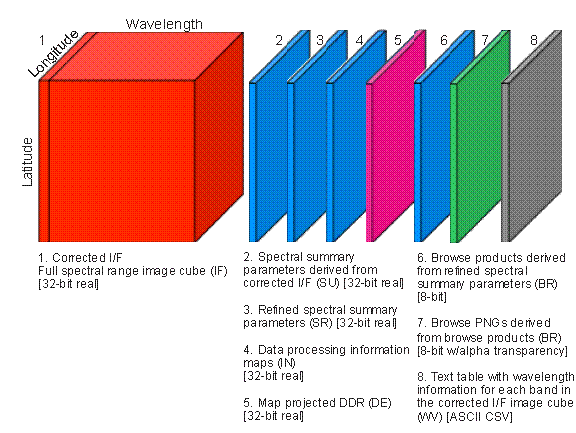 |
A TER or MTRDR product set (Figure 3-15) contains five or six types of multiple-band image objects (IF, SU, SR, IN, BR, DE (MTR only)), one type of PNG document (BR), and a single ASCII table file (WV). All genetically related TER/MTRDR data products have identical spatial dimensions.
Figure 3-15. Contents of a CRISM MTRDR.
3.3. Index Directory Contents
Files in the Index Directory (Table 3-16) are provided to help the user locate products on this archive volume. The following files are contained in the Index Directory. If an archive is divided among two or more physical volumes, the file INDEX.TAB lists the contents of an individual volume, and CUMINDEX.TAB lists the contents of all the volumes.
Table 3-16. Index Directory Contents.
|
File Name |
Required? |
File Contents |
File Provided By |
|
INDXINFO.TXT |
Yes |
A description of the contents of this directory |
Geosciences |
|
FFFYYMM_INDEX.TAB |
Yes |
A table listing all data products of file type FFF on this volume, covering the time span within year YY and month MM |
Geosciences |
|
FFFYYMM_INDEX.LBL |
Yes |
A PDS detached label that describes FFFYYMM_INDEX.TAB |
Geosciences |
|
FFFYYMM_BRINDEX.TAB |
Yes |
A table listing all browse products of file type FFF on this volume, covering the time span within year YY and month MM (TRDR, MTR, and TER volumes only) |
Geosciences |
|
FFFYYMM_BRINDEX.LBL |
Yes |
A PDS detached label that describes FFFYYMM_BRINDEX.TAB (TRDR, MTR, and TER volumes only) |
Geosciences |
|
CUMINDEX.TAB |
No |
A cumulative listing of all data products on this volume and on previous volumes in this set |
Geosciences |
|
CUMINDEX.LBL |
No |
A PDS detached label that describes CUMINDEX.TAB |
Geosciences |
Table 3-17 lists the columns in the index file. They are the most significant keywords pulled from labels of the various products. The list is comprehensive in the sense that it includes the important keywords for all data products. For any given data product, some of the fields are inapplicable and will be set to N/A.
Table 3-17. Index Table Contents.
|
Column |
Format |
Length (bytes) |
Example |
|
VOLUME_ID |
CHARACTER |
12 |
MROCR_0001 |
|
PRODUCT_ID |
CHARACTER |
28 |
HRS00000101_07_SC173L_EDR0 |
|
PRODUCT_TYPE |
CHARACTER |
5 |
EDR |
|
FILE_SPECIFICATION_NAME |
55 |
EDR/2006/2006_350/FRT00001270/ FRT00001270_01_SC001S_EDR0.IMG |
|
|
PRODUCT_CREATION_TIME |
TIME |
19 |
2005-03-02T00:53:38 |
|
PARTICIPATING_INSTRUMENTS |
CHARACTER |
6 |
CHXSM |
|
SPACECRAFT_CLOCK_START_COUNT |
CHARACTER |
17 |
6/881332999:30121 (leading digit is |
|
SPACECRAFT_CLOCK_STOP_COUNT |
CHARACTER |
17 |
6/881333057:21547 partition) |
|
ORBIT_NUMBER |
CHARACTER |
6 |
12345A |
|
START_TIME |
TIME |
19 |
2005-03-02T00:53:38 |
|
STOP_TIME |
TIME |
19 |
2005-03-02T00:53:38 |
|
LOWER_RIGHT_LATITUDE |
ASCII_REAL |
7 |
-88.345 |
|
LOWER_RIGHT_LONGITUDE |
ASCII_REAL |
8 |
-189.345 |
|
LOWER_LEFT_LATITUDE |
ASCII_REAL |
7 |
-88.345 |
|
LOWER_LEFT_LONGITUDE |
ASCII_REAL |
8 |
-189.345 |
|
UPPER_RIGHT_LATITUDE |
ASCII_REAL |
7 |
-88.345 |
|
UPPER_RIGHT_LONGITUDE |
ASCII_REAL |
8 |
-189.345 |
|
UPPER_LEFT_LATITUDE |
ASCII_REAL |
7 |
-88.345 |
|
UPPER_LEFT_LONGITUDE |
ASCII_REAL |
8 |
-189.345 |
|
CENTER_LATITUDE |
ASCII_REAL |
7 |
-30.000 |
|
CENTER_LONGITUDE |
ASCII_REAL |
8 |
-130.000 |
|
OBSERVATION_TYPE |
CHARACTER |
3 |
HRS |
|
OBSERVATION_ID |
CHARACTER |
8 |
12345678 |
|
MRO:OBSERVATION_NUMBER |
ASCII_INTEGER |
2 |
07 |
|
MRO:ACTIVITY_ID |
CHARACTER |
5 |
SC173 |
|
MRO:SENSOR_ID |
CHARACTER |
1 |
L |
|
PRODUCT_VERSION_ID |
CHARACTER |
1 |
0 |
|
TARGET_CENTER_DISTANCE |
ASCII_REAL |
13 |
123456789.123 |
|
SOLAR_DISTANCE |
ASCII_REAL |
13 |
123456789.123 |
|
SHUTTER_MODE_ID |
CHARACTER |
6 |
CLOSED |
|
LIGHT_SOURCE_NAME |
CHARACTER |
13 |
SPHERE LAMP 1 |
|
CALIBRATION_LAMP_STATUS |
CHARACTER |
11 |
CLOSED LOOP |
|
CALIBRATION_LAMP_LEVEL |
ASCII_INTEGER |
4 |
1130 |
|
PIXEL_AVERAGING_WIDTH |
ASCII_INTEGER |
2 |
10 |
|
INSTRUMENT_POINTING_MODE |
CHARACTER |
16 |
DYNAMIC POINTING |
|
SCAN_MODE_ID |
CHARACTER |
5 |
SHORT |
|
MRO:FRAME_RATE |
ASCII_REAL |
5 |
30.00 |
|
MRO:EXPOSURE_PARAMETER |
ASCII_INTEGER |
3 |
439 |
|
SAMPLING_MODE_ID |
CHARACTER |
9 |
HYPERSPEC |
|
COMPRESSION_TYPE |
CHARACTER |
5 |
8_BIT |
|
MRO:WAVELENGTH_FILTER |
CHARACTER |
1 |
0 |
|
MRO:WAVELENGTH_FILE_NAME |
CHARACTER |
26 |
CDR6_0000000000_WV_L_1.TAB |
|
MRO:PIXEL_PROC_FILE_NAME |
CHARACTER |
26 |
CDR6_0000000000_PP_L_1.TAB |
|
MRO:LOOKUP_TABLE_FILE_NAME |
CHARACTER |
26 |
CDR6_0000000000_LK_J_0.TAB |
|
MRO:DETECTOR_TEMPERATURE |
ASCII_REAL |
8 |
-130.000 |
|
MRO:OPTICAL_BENCH_TEMPERATURE |
ASCII_REAL |
8 |
-130.000 |
|
MRO:SPECTROMETER_HOUSING_TEMP |
ASCII_REAL |
8 |
-130.000 |
|
MRO:SPHERE_TEMPERATURE |
ASCII_REAL |
8 |
-130.000 |
|
MRO:FPE_TEMPERATURE |
ASCII_REAL |
8 |
-130.000 |
|
LINES |
ASCII_INTEGER |
4 |
2700 |
|
LINE_SAMPLES |
ASCII_INTEGER |
4 |
320 |
|
BANDS |
ASCII_INTEGER |
3 |
438 |
|
MAP_RESOLUTION |
ASCII_INTEGER |
4 |
4096 |
|
MAXIMUM_LATITUDE |
ASCII_REAL |
7 |
-30.000 |
|
MINIMUM_LATITUDE |
ASCII_REAL |
7 |
-30.000 |
|
WESTERNMOST_LONGITUDE |
ASCII_REAL |
8 |
-130.000 |
|
EASTERNMOST_LONGITUDE |
ASCII_REAL |
8 |
-130.000 |
3.4. Document Directory Contents
The Document Directory (Table 3-18) contains documentation to help the user understand and use the archive data. The following files are contained in the Document Directory.
Table 3-18. Document Directory Contents.
|
File Name |
Required? |
File Contents |
File Provided By |
|
DOCINFO.TXT |
Yes |
A description of the contents of this directory |
CRISM |
|
CRISM_DPSIS.PDF |
No |
The CRISM Data Product SIS as a PDF file |
CRISM |
|
CRISM_DPSIS.HTM |
No |
The CRISM Data Product SIS as an HTML file |
CRISM |
|
CRISM_DPSIS.LBL |
No |
A PDS detached label that describes CRISM_DPSIS.PDF and CRISM_DPSIS.HTM |
CRISM |
|
CRISM_AVSIS.PDF |
No |
The CRISM Archive Volume SIS (this document) as a PDF file |
CRISM |
|
CRISM_AVSIS.HTM |
No |
The CRISM Archive Volume SIS (this document) as an HTML file |
CRISM |
|
CRISM_AVSIS.LBL |
No |
A PDS detached label that describes CRISM_AVSIS.PDF and CRISM_AVSIS.HTM |
CRISM |
|
SEELOS_2014.PDF |
No |
Reference for the MRO/CRISM TER/MTRDR data processing pipeline (TER and MTR volumes only) |
CRISM |
|
SEELOS_2014_PAGE1.HTM |
|
Page 1 of SEELOS_2014.PDF as HTML text (TER and MTR volumes only) |
CRISM |
|
SEELOS_2014_PAGE2.PNG |
|
Page 2 of SEELOS_2014.PDF as a PNG image (TER and MTR volumes only) |
CRISM |
|
SEELOS_2014.LBL |
|
A PDS detached label that describes the SEELOS_2014 documents (TER and MTR volumes only) |
CRISM |
|
PDSDD.FUL |
Yes when a local data dictionary is used |
The PDS Data Dictionary that includes definitions of all keywords used in MRO data labels, including MRO-specific keywords (i.e. the MRO Local Data Dictionary). This is a text file that is human-readable and also usable as input to PDS label validation software. |
Geosciences |
|
PDSDD.IDX |
Yes when a local data dictionary is used |
An index to PDSDD.FUL, used by PDS validation software |
Geosciences |
|
PDSDD.LBL |
Yes when a local data dictionary is used |
A PDS detached label that describes the above two PDSDD files |
Geosciences |
3.5. Catalog Directory Contents
The files in the Catalog Directory (Table 3-19) provide a top-level understanding of the mission, spacecraft, instruments, and data sets. The files in this directory become part of the PDS Catalog to provide background information for the user searching for data. Their format and contents are further specified in the PDS Standards Reference (Applicable Document 6). The following files are found in the Catalog Directory.
Table 3-19. Catalog Directory Contents.
|
File Name |
Required? |
File Contents |
File Provided By |
|
CATINFO.TXT |
Yes |
A description of the contents of this directory |
CRISM |
|
nnnnn_DS.CAT |
Yes |
Data set description, where nnnnn is replaced by EDR, DDR, LDR, CDR, TRDR, MRDR, TER, or MTR |
CRISM |
|
INSTHOST.CAT |
Yes |
MRO instrument host (i.e., spacecraft) description |
MRO Project |
|
CRISM_INST.CAT |
Yes |
CRISM instrument description |
CRISM |
|
EDR_DS.CAT |
Yes |
Description and history of EDR files |
CRISM |
|
DDR_DS.CAT |
Yes |
Description and history of DDR files |
CRISM |
|
TRDR_DS.CAT |
Yes |
Description and history of TRDR files |
CRISM |
|
LDR_DS.CAT |
Yes |
Description and history of LDR files |
CRISM |
|
TER_DS.CAT |
Yes |
Description and history of TER files |
CRISM |
|
MTR_DS.CAT |
Yes |
Description and history of MTRDR files |
CRISM |
|
MTR_MAP.CAT |
Yes |
CRISM MTR data set map projection information for equatorial region (MTRDR volumes only) |
CRISM |
|
MRR_DS.CAT |
Yes |
Description and history of MRDR files |
CRISM |
|
MRR_MAP.CAT |
Yes |
CRISM MRR data set map projection information for equatorial region (MRDR volumes only) |
CRISM |
|
MRR_POLAR_MAP.CAT |
Yes |
CRISM MRR data set map projection information for polar region (MRDR volumes only) |
CRISM |
|
VRDR_DS.CAT |
Yes |
Description and history of VRDR files |
CRISM |
|
VRR_MAP.CAT |
Yes |
CRISM VRR data set map projection information for equatorial region (VRDR volumes only) |
CRISM |
|
VRR_POLAR_MAP.CAT |
Yes |
CRISM VRR data set map projection information for polar region (VRDR volumes only) |
CRISM |
|
MISSION.CAT |
Yes |
MRO mission description |
MRO Project |
|
PERSON.CAT |
Yes |
Contact information for CRISM and Geosciences personnel responsible for generating the archive |
CRISM |
|
REF.CAT |
Yes |
Complete citations of references mentioned in other *.CAT files |
CRISM |
3.6. Label Directory Contents
The Label Directory (Table 3-20) contains files that describe data format and organization; for example, the definition, size, data type, etc. of each column in a table (file with a *.TAB suffix). These format files (*.FMT suffix) are referenced by PDS labels that accompany data products. They are "include" files that are intended to be parsed as if they were part of the PDS labels that point to them .The purposes of keeping this information in a separate file are (a) to keep labels short and (b) to allow the information to be updated without having to update many labels. The following files are contained in the Label Directory.
Table 3-20. Label Directory Contents.
|
File Name |
Required? |
File Contents |
File Provided By |
|
LABINFO.TXT |
Yes |
A description of the contents of this directory |
CRISM |
|
*.FMT files |
Yes |
Generic descriptions of contents of EDR and TRDR TAB files containing housekeeping |
CRISM |
3.7. Calib Directory Contents
The Calib directory (Table 3-21) contains various reports documenting different aspects on instrument behavior.
Table 3-21. Calib Directory Contents
|
File Name |
Required? |
File Contents |
File Provided By |
|
CALINFO.TXT |
Yes |
A description of the contents of this directory (EDR volumes only) |
CRISM |
|
|
No |
Various calibration reports as PDF files (EDR volumes only) |
CRISM |
|
*.HTM |
No |
Various calibration reports as HTML files (EDR volumes only) |
CRISM |
|
*.LBL |
No |
PDS detached labels that describe the calibration reports (EDR volumes only) |
CRISM |
3.8. Geometry Directory Contents
The Geometry Directory contains a single file, GEOMINFO.TXT, which directs the reader to the various SPICE kernels that contain the data necessary to interpret observation geometry.
Four types of SPICE kernels are needed to calculate CRISM's pointing:
1) Frames kernel (FK). This file defines the relationships of the of CRISM's field of view to the spacecraft, with the gimbal at "nadir". These transformations in frames of reference include:
· gimbal base (MRO_CRISM_BASE) -> spacecraft (MRO_SPACECRAFT)
· optical axis at gimbal "nadir" (MRO_CRISM_OSU) -> gimbal base (MRO_CRISM_BASE)
· (the gimbal C kernel defines the relationship of optic axis at a gimbal position to the gimbal nadir)
· (the gimbal offset defines the software offset between commanded nadir and physical nadir)
· IR zero position for IK (MRO_CRISM_IR) -> optical axis (MRO_CRISM_OSU); nominal there two are coaligned and offsets of the IR FOV from the optical axis are entirely accounted for in the IK
· VNIR zero position for IK (MRO_CRISM_VNIR) -> optical axis (MRO_CRISM_OSU); nominal there two are coaligned and offsets of the VNIR FOV from the optical axis are entirely accounted for in the IK
Graphically, this is:
MRO_SPACECRAFT
|
MRO_CRISM_BASE
|
|<--- gimbal ck
|
|<--- gimbal offset
|
MRO_CRISM_OSU
| |
| MRO_CRISM_IR
|
MRO_CRISM_VNIR
The CRISM frames kernel is delivered to NAIF and is incorporated into the MRO frames kernel.
2) Instrument kernel (IK). This file describes the relationship of position of each detector element (at a row or wavelength and spatial or column position) to a zero position within the field of view. Nominally, that is in the VNIR row closest to 610 nm or the IR row closest to 2300 nm, at the column position closest to the optical axis. Due to keystone distortion, there is a different relationship for every row number of either detector.
The CRISM instrument kernel is delivered to NAIF.
3) Gimbal C kernel. This file gives a time history of the angle of the gimbal within the gimbal plane, relative to its commanded nadir. It is constructed from gimbal attitude measurements in image headers, i.e., from the TAB file part of an EDR. One file covers a 2-week time span of CRISM data.
CRISM gimbal C kernels are delivered to NAIF.
4) Metakernel. This file gives, for any time span covered by a gimbal C kernel, the MRO and CRISM SPICE kernels used to create DDRs for observations occurring during that time period. Note that kernels are loaded in the order listed., so the highest priority kernel is listed last.
CRISM metakernels are delivered with CRISM image and supporting data to the PDS Geoscience Node.
The file naming convention CRISM-generated SPICE kernels is as follows.
MRO_CRISM_(KernelType)_(YYYY_DOY)_(Filetype)_(version).(Ext)
where:
Kernel Type =
FK (frames kernel)
IK (instrument kernel)
CK (gimbal C-kernel)
MK (metakernel)
YYYY_DOY is the year and day of year of the start of a 2-week period covered in a single gimbal C kernel or metakernel; or else these fields are filled with zeroes
Filetype =
P for predicted
R for reconstructed
N for not applicable
version = 0, 1,...,9, a, ..., z
Ext =
TI (text-format, instrument kernel)
TF (text-format, frames kernel)
BC (binary-format, gimbal C kernel)
BO (binary-format, gimbal offset C kernel)
TM (text-format, metakernel)
3.9. Browse Directory Contents
The BROWSE directory contains synoptic versions of data products to help identify products of interest. Contents of this directory are provided by the CRISM team. There are browse products for EDRs, TRDRs, MRDRs, VRDRs, TERs, and MTRDRs in the appropriate archive volumes. At the top of the directory structure, BROWINFO.TXT contains a description of the contents of this directory. Within each subdirectory the organization follows that of the directories containing the data products.
3.9.1. EDR Browse Directory
EDR browse products are organized into subdirectories in a structure that parallels that of the EDR directory. That is, by year and DOY, e.g. 2006/2006_350, with subdirectories for each observation named for the combination of class type and observation ID unique to a single observation, e.g. "FRT00001270".
In the subdirectory for the observation, there are two types of products. One is an HTML file that gives the key parameters of the component EDRs and links to PNG files for each EDR. A detached label to the HTML file describes the observation at a high level.
The browse product for each EDR is a scaled (0-255), median DN value from selected wavelengths for each spatial element in an EDR multiband image, stored in PNG format. A detached label to the PNG file describes the source EDR and the scaling between its raw data values and the PNG file.
The file naming convention for the HTML browse products is as follows.
(ClassType)(ObsID)_BROWSE_EDR(version).(Ext)
where:
ClassType =
FRT (Full Resolution Targeted Observation)
HRL (Half Resolution Long Targeted Observation)
HRS (Half Resolution Short Targeted Observation)
FRS (Full Resolution Short Targeted Observation)
ATO (Along-Track Oversampled Targeted Observation)
ATU (Along-Track Undersampled Targeted Observation)
EPF (Atmospheric Survey EPF)
TOD (Tracking Optical Depth Observation)
MSP (Multispectral Survey, losslessly compressed)
HSP (Hyperspectral Survey, losslessly compressed)
HSV (Hyperspectral Survey - VNIR only, pixels 10x-binned)
MSV (Hyperspectral Survey - VNIR only, pixels 5x-binned)
MSW (Multispectral Window)
CAL (Radiometric Calibration)
FFC (Flat Field Calibration)
ICL (Calibration source intercalibration)
FUN (Functional test)
UNK (no valid EDRs within observation that indicate class type)
ObsID = nnnnnnnn, Observation ID, unique for the whole CRISM mission, expressed as a hexadecimal number
version = 0, 1,...,9, a, ..., z
Ext = HTML
The file naming convention for the PNG browse products is as follows.
(ClassType)(ObsID)_(Counter)_ (Activity)(SensorID)_RAW(version).(Ext)
where:
Counter = nn, a monotonically increasing ordinal counter of EDRs from one Observation ID
Activity = for an EDR, type of observation, e.g.
BInnn – Bias measurements / Macro#
DFnnn – Dark field measurements / Macro#
LPnnn – Lamp measurements / Macro #
SPnnn – Sphere measurements / Macro #
SCnnn – Scene measurements / Macro #
T1nnn – Focal plane electronics test pattern 1 / Macro #
T2nnn – Focal plane electronics test pattern 2 / Macro #
T3nnn – Focal plane electronics test pattern 3 / Macro #
T4nnn – Focal plane electronics test pattern 4 / Macro #
T5nnn – Focal plane electronics test pattern 5 / Macro #
T6nnn – Focal plane electronics test pattern 6 / Macro #
T7nnn – Focal plane electronics test pattern 7 / Macro #
UNnnn – Instrument configuration does not match macro library / Macro #
SensorID = S for VNIR, or L for IR
version = 0, 1,...,9, a, ..., z
Ext = PNG
3.9.2. MRDR Browse Directory
MRDR browse products are organized in a fashion paralleling the MRDRs. That is, they are organized into 30 subdirectories named by the Mars Chart containing the latitude and longitude of its upper left corner, e.g. MC01. Latitude and longitude limits of Mars Charts are given in Table 3-12. Formulations of the MRDR spectral summary products and browse products are identical to those for TER/MTRDR spectral summary products and browse products, with the important caveat that the source spectral data for the MRDR product set is multispectral. Thus single wavelengths are used for the terms in the expressions to calculate MRDR spectral summary products; in contrast for TERs and MTRDRs, the values for the terms are fit over several wavelengths surrounding the central wavelength for that term. The MRDR summary and browse products are similar but non-identical to the TER/MTRDR summary and browse products. A detached label describes the files present. The three included data files are:
An .IMG file which stores the browse image as a 3-band 8-bit raw binary PDS image object.
A .HDR file which stores ENVI Header information associated with the IMG file. This file is provided as a convenience to users of the ENVI software and allows the MRDR browse products to be loaded directly into ENVI.
A .PNG file which stores the 3-band 8-bit browse image in Portable Network Graphics (PNG) format.
The file naming convention for an MRDR browse product is as follows.
(Tile)_(ProductType)(BrowseProductType)_ (CLat)(Hemisphere) (CLon)_(Resolution)_version.(Ext)
where:
Tile = Tnnnn, tile number with tile 0001 at the south pole, increasing spiraling northward
Product Type = MRR
BrowseProductType = TRU, VNA, FEM, FM2, FAL, IRA, MAF, HYD, PHY, PFM, PAL, HYS, ICE, IC2, CAR, CR2, CHL, or TAN (described in the Data Product SIS)
CLat = nn, Planetocentric latitude of center of the tile
Hemisphere = #, N or S for north or south latitude
CLon = nnn, East longitude of center of the tile (rounded)
Resolution = nnnn, in map-projected pixels per degree, e.g. 256 pixels per degree
version = 0, 1,..., 9, a,..., z
Ext = PNG, IMG, HDR, or LBL
3.9.3. VRDR Browse Directory
VRDR browse products are organized in a fashion paralleling the VRDRs. That is, they are organized into 30 subdirectories named by the Mars Chart containing the latitude and longitude of its upper left corner, e.g. MC01. Latitude and longitude limits of Mars Charts are given in Table 3-12. Formulations of the VRDR spectral summary products and browse products are identical to those for TER and MTRDR spectral summary products and browse products, with the important caveat that only those products sourced from VNIR-only data are present. A detached label describes the files present. The three included data files are:
An .IMG file which stores the browse image as a 3-band 8-bit raw binary PDS image object.
A .HDR file which stores ENVI Header information associated with the IMG file. This file is provided as a convenience to users of the ENVI software and allows the TRDR browse products to be loaded directly into ENVI.
A .PNG file which stores the 3-band 8-bit browse image in Portable Network Graphics (PNG) format.
The file naming convention for an VRDR browse product is as follows.
(Tile)_(ProductType)(BrowseProductType)_ (CLat)(Hemisphere) (CLon)_(Resolution)_version.(Ext)
where:
Tile = Tnnnn, tile number with tile 0001 at the south pole, increasing spiraling northward
Product Type = VRR
BrowseProductType = TRU, VNA, FEM, or FM2 (described in the Data Product SIS)
CLat = nn, Planetocentric latitude of center of the tile
Hemisphere = #, N or S for north or south latitude
CLon = nnn, East longitude of center of the tile (rounded)
Resolution = nnnn, in map-projected pixels per degree, 654 pixels per degree
version = 0, 1,..., 9, a,..., z
Ext = PNG, IMG, HDR, or LBL
3.9.4. TRDR Browse Directory
Each hyperspectral targeted (gimbaled) observation TRDR IF data product may have one corresponding browse product in a directory structure that parallels a product present in the TER/MTRDR directory. That is, by year and DOY, e.g. /2006/2006_350/, with subdirectories for each observation named according to the combination of class type and observation ID unique to a single observation, e.g. "FRT00001270". Each VNIR (S-detector) TRDR may have a TRU browse product visualization, and each IR (L-detector) TRDR may have a FAL browse product visualization. Like the TER/MTRDR browse products, three data files and one detached PDS label file describing the three files constitutes a single TRDR browse product set. The three included data files are:
The .IMG file which stores the browse image as a 3-band 8-bit raw binary PDS image object.
The .HDR file which stores ENVI Header information associated with the IMG file. This file is provided as a convenience to users of the ENVI software and allows the TRDR browse products to be loaded directly into ENVI.
The .PNG file which stores the 3-band 8-bit browse image in Portable Network Graphics (PNG) format with an alpha transparency channel that corresponds to the non-scene edge pixels.
The spatial dimensions of each PNG and IMG file match the spatial dimensions of the source TRDR.
3.9.5. TER/MTRDR Browse Directories
TER and MTRDR browse products are organized in the appropriate BROWSE directory tree by year and day of year, e.g. /2007/2007_013/, with subdirectories for each observation identified by the class type and target ID (e.g. /FRT00003E12/).
Three data files and one detached PDS label file describing the three data files constitutes a single TER/MTRDR browse product set. The three data files are:
The .IMG file which stores the browse image as a 3-band 8-bit raw binary PDS image object.
The .HDR file which stores ENVI Header information associated with the IMG file. This file is provided as a convenience to users of the ENVI software and allows the TER and MTRDR browse products to be loaded directly into ENVI. For the map projected (MTR) data products the ENVI header also includes a coordinate system string generated by the ESRI Projection Engine (PE) that allows the products to be loaded into a GIS environment.
The .PNG file which stores the 3-band 8-bit browse image in Portable Network Graphics (PNG) format with an alpha transparency channel that corresponds to the non-scene edge pixels.
The spatial dimensions of each PNG and IMG file match the spatial dimensions of the source TER or MTRDR.
The detached PDS label describes the three data files and includes traceability information for the source TER/MTRDR spectral summary parameter data product. For projected (MTR) products image map projection information that applies to both the PNG and IMG file is included. The label also records the scaling between the source 32-bit TER/MTRDR summary parameter data values and the 8-bit browse image files.
There are up to four browse products containing data derived from the VNIR detector, and up to thirteen browse products containing data derived from the IR detector. A single browse product (TAN) includes data from both detectors. A TER/MTRDR product set with sensor type J (“joined”) has associated browse products from both detectors for a total of 18 products. A detailed description of the TER/MTRDR browse products is provided in the CRISM Data Product SIS.
The file naming convention for the TER and MTRDR browse products is as follows.
(ClassType)(ObsID)_(Counter)_ BR(BrowseProductType)_(Filetype)(version).(Ext)
where:
Class Type =
FRT (Full Resolution Targeted Observation)
HRL (Half Resolution Long Targeted Observation)
HRS (Half Resolution Short Targeted Observation)
ObsID = nnnnnnnn, Observation ID, unique for the whole CRISM mission, expressed as a hexadecimal number
Counter = nn, the ordinal counter carried through from the source EDR
BrowseProductType = TRU, VNA, FEM, FM2, FAL, IRA, MAF, HYD, PHY, PFM, PAL, HYS, ICE, IC2, CAR, CR2, CHL, or TAN (described in the Data Product SIS)
Filetype = “TER” or “MTR”
version = 0, 1,...,9, a, ..., z
Ext = PNG, HDR, IMG, LBL
3.10. Extras Directory Contents
An Extras directory may be present and if so contains additional materials that the user may find helpful, but that are beyond the scope of the required elements of the archive. This includes a time ordered history of observations and the characteristics of the sites observed (EDR Extras), configuration-managed history of the hardware and software state of the CRISM instrument (EDR), visualizations of the observation geometry, content, and structure (TRDR, TER), data processing visualizations that illustrate the spatial and spectral impact of TER/MTRDR data processing procedures (TER), and visualizations of fully corrected sensor space (TER) and map-projected hyperspectral (MTR) image cubes.
3.10.1. EDR Extras Directory
Six subdirectories contain engineering-related files, which a format and nomenclature like that of level 6 CDRs but are maintained separately due to the difference in content. They are used in mission operations and potentially have value to troubleshooting data products, and the level 6 CDR format was used as a convenience. Hence they are called "operational CDRs." These are described in Table 3-22.
CP subdirectory: This contains a model of the lossless compressibility of CRISM data. For every combination of binning, wavelength filter, lossless on or off, lossy compression on or off, and type of scene (background or bias calibration, scene or calibration lamps, or test pattern) the expect compression ratio is given with respect to uncompressed 12-bit data.
DC subdirectory: This contains the history of values loaded into selected data structures ('alarm limits' and 'parameters' per the CRISM software specification), as well as the start times at which that update became applicable. If a set of values is planned but not yet active, that is also indicated. The alarm limits are all in calibrated form in volts, degrees Celsius, or amperes.
DR subdirectory: This contains the history of values loaded into selected data structures ('alarm limits' and 'parameters' per the CRISM software specification), as well as the start times at which that update became applicable. If a set of values is planned but not yet active, that is also indicated. The alarm limits are all in raw form corresponding to 16-bit housekeeping values to which the alarms are keyed.
EL subdirectory: This subdirectory contains time-stamped summaries of key activities during CRISM flight operations. Typical entries include major flight calibrations, power cycles, and macro loads. In addition a running total is kept of cooler on time, gimbal cycles, and shutter cycles.
SC: This subdirectory contains information on the goals and hystereses for heaters and coolers. These are all set in software and the default state is off. The files give the values as well as the start times at which an update became applicable. If a set of values is planned but not yet active, that is also indicated. The values are all in calibrated form in degrees Celsius.
SR: This subdirectory contains information on the goals and hystereses for heaters and coolers. These are all set in software and the default state is off. The files give the values as well as the start times at which an update became applicable. If a set of values is planned but not yet active, that is also indicated. The values are all in raw form corresponding to 16-bit housekeeping values to which the alarms are keyed.
Table 3-22. Descriptions of operational level-6 CDRs
|
PRODUCTS |
FORM FOR EACH FOCAL PLANE |
PRODUCT ACRONYM |
|
Digital values of alarm limits and instrument parameters. Used for validation of uplinked sequences. |
ASCII table with columns of start time of applicability, raw digital value, and comments (only one file applicable to both VNIR and IR) |
DR |
|
Calibrated physical values of alarm limits. Used for validation of uplinked sequences. |
ASCII table with columns of start time of applicability, value as Celsius, volts, or amps, and comments (only one file applicable to both VNIR and IR) |
DC |
|
Digital values of heater and cooler settings. Used for validation of uplinked sequences. |
ASCII table with columns of start time of applicability, raw digital value, and comments (only one file applicable to both VNIR and IR) |
SR |
|
Calibrated physical values of heater and cooler settings. Used for validation of uplinked sequences. |
ASCII table with columns of start time of applicability, value as Celsius, and comments (only one file applicable to both VNIR and IR) |
SC |
|
Expected compression ratio of data in different instrument con figurations. Used for management of solid state recorder usage. |
ASCII table with columns activity, wavelength filter, binning, lossy compression setup, lossless compression setup, and expected compression ratio of data with that configuration. |
CP |
|
Mission event log. Includes times of updates to instrument software or settings, command loads, flight tests, or other notable events. |
ASCII table with columns of start time and comments (only one file applicable to both VNIR and IR) |
EL |
Two other subdirectories document the observing history of CRISM.
MACROS: This subdirectory contains information on the characteristics of flight macros that were active during different periods of the MRO mission. The macros have several functions: some control engineering functions like powering subsystems. Others are called by internal autonomy if certain housekeeping items exceed alarm limits. Most of the macros are used for data acquisition: observations are triggered by sequential execution of several macros. There are three files for each macro load: the macro dictionary itself, a summary of each macro's function, and a description of the image data generated by each macro.
OTT: This subdirectory contains ASCII tables (Table 3-23) that connect specific observations with regions of interest on Mars, science objectives, and specific observation conditions. There are five tables whose contents are described in detail in the Data Products SIS. For the SITE_ID, ANCILLARY, REQ_ID, and CORRESP tables there may be one table for the mission, and the string YYYY_MM_DD is the date of the last update. For the OBS_ID table, there are multiple tables, each covering a time span of the month YYYY_MM_00.
(a) A site ID table describing the locations and physical features of sites of interest on Mars, compiled by the CRISM science team. This table defines the intended targets of observations by full and half resolution targeted observations or multispectral windows (see Applicable Document 3 for definitions of each class of observation; this implies CLASS= FRT, HRS, HRL, or MSW).
(b) An ancillary information table describing physical properties of a 0.25°x0.25° region centered on the center point of each site ID.
(c) For each site ID, a table of request IDs. There is at least one entry specifying the desired observing conditions such as Ls. For site IDs desired to be observed repeatedly, there are multiple entries.
(d) An observation ID table summarizing the date and characteristics of each observation actually taken.
(e) A correspondence table in which one line gives a site ID, request ID, and target ID where there is geographic overlap. For example, all the lines containing a particular site ID include the target IDs that cover it.
Table 3-23. Contents of the EXTRAS/OTT subdirectory
|
File Name |
File Contents |
Required? |
File Provided By |
|
SITE_ID_YYYY_MM_DD.TAB |
OPTIONAL: Description of the locations and physical features of sites of interest on Mars, compiled by the CRISM science team. Date is last update. |
No |
CRISM |
|
SITE_ID_YYYY_MM_DD.HDR |
OPTIONAL: Header record to site ID table. |
No |
CRISM |
|
SITE_ID_YYYY_MM_DD.LBL |
OPTIONAL: Label to site ID table. |
No |
CRISM |
|
ANCILLARY_YYYY_MM_DD.TAB |
OPTIONAL: Tabulated statistics on physical properties of sites of interest on Mars, compiled by the CRISM science team . Date is last update. |
No |
CRISM |
|
ANCILLARY_YYYYMMDD.HDR |
OPTIONAL: Header record to ancillary information table. |
No |
CRISM |
|
ANCILLARY_YYYYMMDD.LBL |
OPTIONAL: Label to ancillary information table. |
No |
CRISM |
|
REQ_ID_MC##-####_YYYY_MM_DD.TAB |
OPTIONAL: A table of request IDs, with one or more entries, specifying the desired observing conditions such as Ls. One table per site ID (MC##-####). |
No |
CRISM |
|
REQ_ID_MC##-####_YYYY_MM_DD.HDR |
OPTIONAL: Generic header record to request ID tables. |
No |
CRISM |
|
REQ_ID_MC##-####_YYYY_MM_DD.LBL |
OPTIONAL: Label to request ID tables. |
No |
CRISM |
|
OBS_ID_YYYY_MM_DD.TAB |
Table summarizing the date and characteristics of each observation actually taken. |
No |
CRISM |
|
OBS_ID_YYYY_MM_DD.HDR |
Header record to observation ID table. |
No |
CRISM |
|
OBS_ID_YYYY_MM_DD.LBL |
Label to observation ID table. |
No |
CRISM |
|
CORRESP_YYYY_MM_DD.TAB |
OPTIONAL: Correspondence table in which one line gives a site ID, request ID, and target ID where there is geographic overlap. |
No |
CRISM |
|
CORRESP_YYYY_MM_DD.HDR |
OPTIONAL: Header record to correspondence table. |
No |
CRISM |
|
CORRESP_YYYY_MM_DD.LBL |
OPTIONAL: Label to correspondence table. |
No |
CRISM |
3.10.2. TRDR Extras Directory
The TRDR EXTRAS visualizations, if present, are Portable Network Graphics (PNG) format files that depict the geometry and structure of CRISM hyperspectral gimbaled targeted observations. The TRDR detector specific visualizations have file names with the form [Class Type][Target ID]_[Sensor]_[Name].PNG where [Class Type] is a three letter observation type code (e.g. FRT, HRL, HRS, FRS, ATO, ATU), [Target ID] is an eight character hexadecimal observation identifier, [Sensor] is a single character indicating the VNIR (S-detector) or IR (L-detector) wavelength range, and [Name] indicates the plot contents.
TRR3 I/F Observation Geometry:
Two CRISM targeted observation geometry plots are color coded with the inbound EPF branch in blue, the central scan in green, and the outbound EPF branch in red.
[Class Type][Target ID]_[Sensor]_PHA_EMI.PNG – Cartesian plot showing phase angle (g) vs. emission angle (e). The observation median incidence angle is plotted as a black sun symbol at [g = i, e = i] for completeness. The minimum sampled emission angle is marked by a black asterisk on the abscissa. This value approximates the S/C roll angle, ignoring planetary curvature. The minimum and maximum phase angle sampled by each observation section (inbound EPFs, central scan, outbound EPFs) are marked with colored asterisks on the ordinate.
[Class Type][Target ID]_[Sensor]_EMI_AZI.PNG – Polar plot showing emission angle (e) vs. azimuth angle (ψ). The 360° azimuth space has been folded about the principal plane (ψ = 0°; ψ = 180°) to reduce redundancy. In this coordinate system the sub-solar azimuth is ψ = 180° and the zero phase point lies along ψ = 0°. The incidence angle is plotted as a black sun symbol at [e = i, ψ = 90° + i] for completeness.
TRR3 I/F Observation Structure:
Two CRISM targeted observation structural plots provide visibility into the spatial, spectral, and geometric variability.
[Class Type][Target ID]_[Sensor]_GIMBALED.PNG – Multi-component plot with the targeted observation sections color-coded as in the geometric plots (inbound EPFs in blue, central scan in green, outbound EPFs in red). (Bottom) Median spectrum of each targeted observation segment. The dotted vertical line indicates the reference wavelength for the other plot components. (Middle) Distribution boxplots for each observation segment. The vertical dotted and dashed lines indicate the stretch limits for the remaining plot components. (Upper Left) All observation segments at the reference wavelength displayed with the stretch limits indicated by the dotted vertical lines in the distribution boxplot component. The central scan is shown at a reduced spatial sampling. (Upper Right) Observation central scan at the reference wavelength show at full spatial resolution with the stretch limits indicated by the dashed vertical lines in the distribution boxplot component.
[Class Type][Target ID]_[Sensor]_COMPOSITE.PNG - A three panel display showing the spectral variability of the targeted observation central scan. The visualization includes a false color RGB composite with a 0.5% linear stretch on each band, a spectral plot with the scene median and 5%-95% spectral envelope (dashed lines indicate RGB band wavelengths), and distribution boxplots for the three bands in the RGB composite (dashed lines indicate RGB band stretch limits).
3.10.3. TER/MTRDR Extras Directories
The Targeted Empirical Record (TER) EXTRAS directory contains a series of data processing visualizations for each CRISM hyperspectral targeted observation that has been processed through the Map-projected Targeted Reduced Data Record (MTRDR) pipeline. These visualizations collectively depict the geometric structure of the source TRR3 I/F spectral data, illustrate the spatial and spectral impact of the TER/MTRDR data processing procedures, and provide snapshots of the underlying modeling behavior of the empirical data processing.
Detailed descriptions of the TER/MTRDR data processing procedures are provided in Appendix P1 of the CRISM Data Product SIS. The MTRDR EXTRAS directory contains one visualization for each processed observation that illustrates the spatial/spectral information content of the primary MTRDR I/F data product. The visualization includes a false color RGB composite with a 0.5% linear stretch on each band, a spectral plot with the scene median and 5%-95% spectral envelope (dashed lines indicate RGB band wavelengths), and distribution boxplots for the three bands in the RGB composite (dashed lines indicate RGB band stretch limits). The TER EXTRAS directory contains multiple visualizations for each processed observation illustrate the spatial and spectral impact of the TER/MTRDR data processing procedures, as described in the CRISM Data Product SIS.
Every TER/MTRDR product set for a given observation that is released to the PDS has been reviewed and approved by members of the CRISM SOC. The information generated by this release review process – including validation of the products and notation of any minor artifacts – is included in a Microsoft Excel format spreadsheet that is stored in the top level TER/MTRDR EXTRAS directories.
All TER/MTRDR EXTRAS visualizations are Portable Network Graphics (PNG) format files. The TER detector specific systematic data processing visualizations have file names with the form [Class Type][Target ID]_[Sensor]_[Name].PNG where [Class Type] is a three letter observation type code (e.g. FRT, HRL, HRS), [Target ID] is an eight character hexadecimal observation identifier, [Sensor] is a single character indicating the VNIR (S-detector), IR (L-detector), or merged (J=joined) wavelength range, and [Name] indicates the plot contents. A detailed description of the TER/MTR EXTRAS data contents are provided in Appendix P2 of the CRISM Data Product SIS.
4. Archive Volume Format
This section describes the format of CRISM Archive Volumes.
4.1. Disk Format
Archive Volumes are formatted so that when written to CD or DVD media according to PDS policy, the media are compatible with most commonly used computer operating systems including Windows, Unix, and Macintosh systems. The CD volume format is in accordance with ISO 9660 level 2 Interchange Standard [Applicable Document 7]. The DVD volume format is in accordance with the UDF Standard with ISO 9660 Level 2 compatibility.
4.2. File Formats
This section describes file formats for the kinds of files contained on Archive Volumes.
4.2.1. Document File Formats
Document files with the .TXT suffix exist in the Root, Index, Catalog, Document, Label, Browse, Calib, and Extras directories. They are ASCII files which may have embedded PDS labels. Lines in a .TXT file end with a carriage return character (ASCII 13) and a line feed character (ASCII 10). This allows the files to be readable under various operating systems.
Some documents in the Document and Calib directories contain formatting and figures that cannot easily be rendered as ASCII text. Therefore each document is given in PDF format. PDF (Portable Document Format) is a proprietary format of Adobe Systems Incorporated that is frequently used for distributing documents. Adobe offers free software, Acrobat Reader, for viewing PDF files. Some type of ASCII text versions of these documents will also be included, possibly using HTML or XML, in order to meet the PDS requirement that documents must be archived as ASCII text.
Macro dictionaries in the MACROS subdirectory of the EXTRAS directory (EDR/CDR volumes only) have the suffix .PY. They are text files whose lines end with a carriage return character (ASCII 13) and a line feed character (ASCII 10). These files have detached labels describing their contents.
4.2.2. Tabular File Format
Tabular files (.TAB suffix) exist in the INDEX, DATA, CALIB, and EXTRAS directory. Tabular files are ASCII files formatted for direct reading into many database management systems on various computers. All fields are separated by commas. (Character fields are padded with spaces to keep quotation marks in the same columns of successive records.) Character fields are left justified, and numeric fields are right justified. The "start byte" listed in the labels indicate the starting position in bytes of each field in a record; the field length "bytes" does not include the commas between fields. The records are of fixed length, and the last two bytes of each record contain the ASCII carriage return and line feed characters. This allows a table to be treated as a fixed length record file on computers that support this file type and as a text file with embedded line delimiters on those that don't.
Every CRISM tabular file is described by a detached PDS label with the same name as the data file it describes, and the extension .LBL. For example, the file INDEX.TAB is accompanied by the detached label file INDEX.LBL in the same directory.
Some multicolumn CRISM tabular files (for example, in the EDR or TRDR directory) are accompanied by a format file with the same name as the data file it describes, and the extension .FMT. A *.FMT file describes the significance of the columns in its corresponding table file, as well as how to use the values listed in the columns.
4.2.3. PDS Label Format
All data files in CRISM the archive have PDS labels detached in a separate file. For examples of PDS labels for each type of data product, see the CRISM Data Product SIS [Applicable Document 3].
A PDS label provides descriptive information about the associated file. The PDS label is an object-oriented structure consisting of sets of 'keyword=value' declarations. The object to which the label refers (e.g. IMAGE, TABLE, etc.) is denoted by a statement of the form:
^object = location
in which the carat character (^, also called a pointer in this context) indicates where to find the object. In an embedded label, the location is an integer representing the starting record number of the object (the first record in the file is record 1). In a detached label, the location denotes the name of the file containing the object, along with the starting record or byte number, if there is more than one object in the file. For example:
^HEADER = ("F01.IMG",1)
^IMAGE = ("F01.IMG",1025 <BYTES>)
indicates that the IMAGE object begins at byte 1025 of the file F01.IMG, in the same directory as the detached label file. Below is a list of the possible formats for the ^object definition.
^object = n
^object = n<BYTES>
^object = "filename.ext"
^object = ("filename.ext",n)
^object = ("filename.ext",n<BYTES>)
where
n is the starting record or byte number of the object, counting from the beginning of the file (record 1, byte 1),
<BYTES> indicates that the number given is in units of bytes,
filename is the up to 28 character, alphanumeric upper‑case file name,
ext is the 3 character upper‑case file extension,
Lines of text in detached labels end with a carriage return character (ASCII 13) and a line feed character (ASCII 10). This allows the files to be readable under various operating systems.
4.2.4. Catalog File Format
Catalog files (suffix .CAT) exist in the ROOT and CATALOG directories. They are text files formatted in an object-oriented structure consisting of sets of 'keyword=value' declarations, so that they are readable by humans and by software.
4.2.5. Science Data File Formats
For more information about the format and content of the data products, see the discussions in section 3 and the CRISM Data Product SIS [Applicable Document 3].
5. Archive Volume Generation
5.1. Data Transfer and Validation
CRISM data products are generated by the CRISM Science Operations Team and delivered to the PDS Geosciences Node according to the schedule in the MRO Archive Plan. CRISM archive volumes are assembled and validated by the PDS Geosciences Node and made available to the public via the Geosciences Node web site. The Geosciences Node also transfers CRISM archive volumes to the National Space Science Data Center (NSSDC) for long term storage, according to PDS policy, using a transfer medium agreed upon by PDS and NSSDC.
5.2. Data Product Sizes and Delivery Rates
Table 5-1 summarizes very approximate expected sizes and production rates for the CRISM Standard Products over one Mars year, using average data collection rates over the Primary and Extended Science Phase (delivery of data collected from 6 Nov 2006 through 27 Sep 2010).
Table 5-1. Standard product sizes and delivery rates per Mars year
|
Class of observation |
# |
Approx. EDR vol per observ-ation, Gb |
Approx. data vol., associated cal. files, Gb |
PDS deliveries |
Data vol per TRDR+DDR for 1 observation, or per MRDR, Gb |
PDS deliveries (initial, redelivery) |
Delivered volume, Tb |
|
Full-res targets |
5000 |
2.10 |
0.23 |
1 |
4.33 |
2 |
53.72 |
|
Half-res long targets |
1500 |
1.09 |
0.05 |
1 |
2.25 |
2 |
8.26 |
|
Half-res short targets |
1000 |
0.62 |
0.05 |
1 |
1.28 |
2 |
3.17 |
|
EPFs |
3000 |
0.10 |
0.03 |
1 |
0.21 |
2 |
1.61 |
|
TODs |
6000 |
0.03 |
0.05 |
1 |
0.06 |
2 |
1.23 |
|
Strips of multispectral survey |
12000 |
0.75 |
0.002 |
1 |
1.83 |
2 |
51.80 |
|
Strips of hyperspectral survey |
6000 |
2.70 |
0.002 |
1 |
5.73 |
2 |
82.93 |
|
Multispectral survey tiles |
1764 |
|
|
|
9.47 |
1 |
16.32 |
|
Multispectral windows |
2000 |
0.75 |
0.0014 |
1 |
1.83 |
2 |
8.63 |
|
Total |
227.66 |
||||||
5.3. Backup and Duplicates
The CRISM Science Team will maintain a backup copy of all data delivered to the Geosciences Node until the end of the MRO Mission. The Geosciences Node will maintain a backup copy of all CRISM data released by PDS as part of the Node's regular data repository backups.
6. Support Staff and Cognizant Persons
Scott Murchie, CRISM Principal Investigator, Johns Hopkins University / Applied Physics Laboratory, Scott.Murchie@jhuapl.edu.
Christopher Hash, CRISM Downlink Lead, Applied Coherent Technology, hash@actgate.com.
Kimberly Seelos, CRISM Science Operations Lead, Johns Hopkins University / Applied Physics Laboratory, kim.seelos@jhuapl.edu
Jennifer Ward, PDS Geosciences Node, Washington University in St. Louis, jgward@wustl.edu
Thomas Stein, PDS Geosciences Node, Washington University in St. Louis, tstein@wustl.edu